
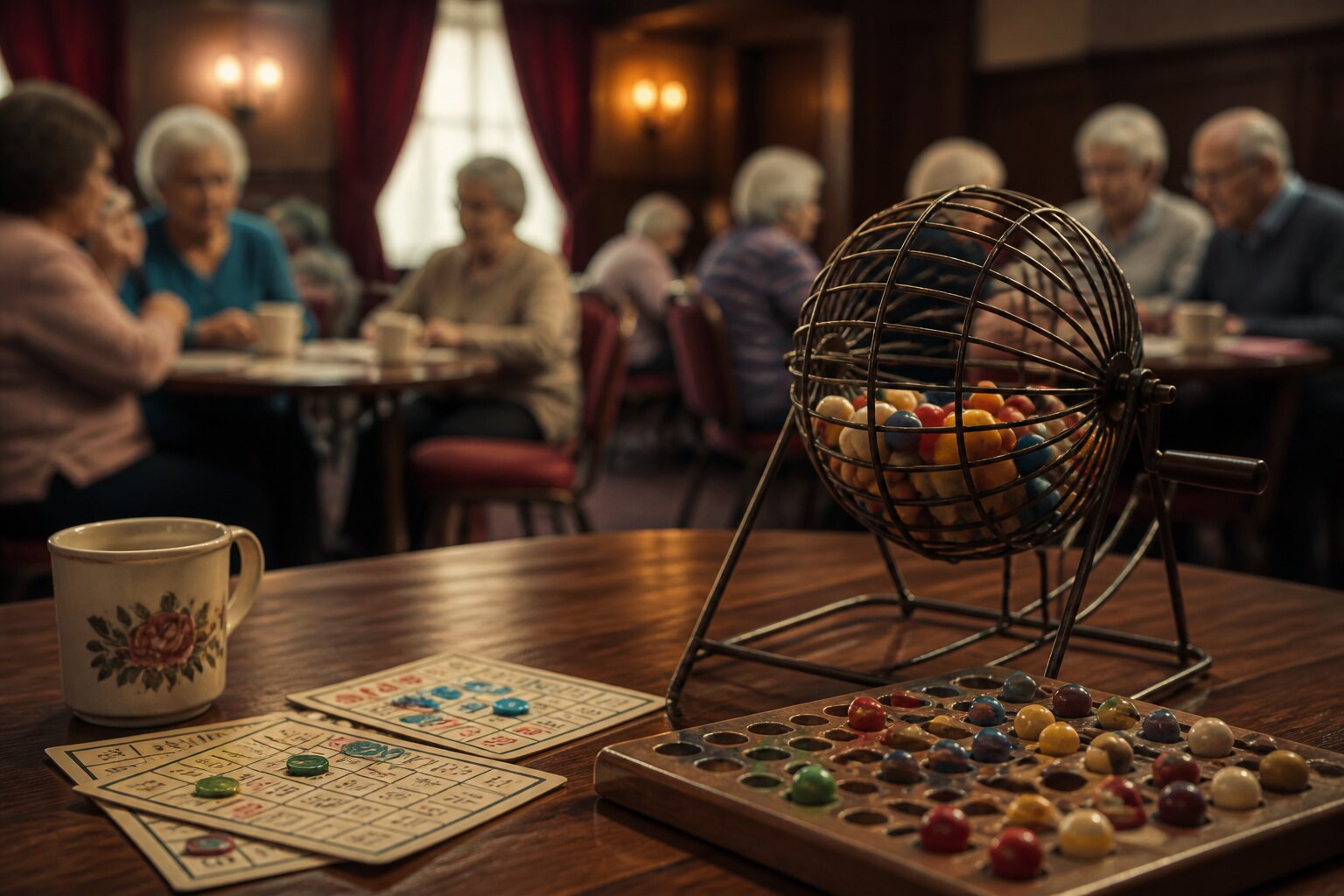
Bingo is a much-loved pastime, valued for its excitement and sense of community. But where did the game begin, and how did a simple format based on random draws become a household fixture in the UK and beyond?
This article traces bingo’s path from early European lotteries to modern halls and sets, introducing the people and social trends that shaped its rules and spread its appeal. Come with me through the key moments and inventions that turned a local game into an international pastime.
Curious to find out more? Keep reading to discover the story behind the numbers.
What Is Bingo & How Did It Begin?
Bingo is played by marking numbers on a card as they are announced, aiming to complete a specific pattern before other players. Traditional cards often require a straight line, though many variations now exist. Prizes and the social atmosphere are central to the game’s appeal.
The earliest ancestor of bingo appears in 16th century Italy as a public lottery called Lo Giuoco del Lotto d’Italia, where numbers were drawn at random and people watched for particular results. By the late 1700s a related form, Le Lotto, had taken root in France. French boards typically used three rows and nine columns, with numbers drawn from a bag by a caller. Across Europe, these number-drawing games were adapted to local tastes, producing a range of card layouts and play styles.
As the basic idea travelled to Britain, the United States and elsewhere it retained its core mechanics—cards, a caller and randomly drawn numbers—while local organisers changed formats and contexts. The following sections look at the cultural settings that helped the game evolve and the individuals who shaped its modern form.
Early Cultural Influences On Bingo’s Development
Bingo grew out of community traditions where people gathered for shared entertainment and socialising. In Italy, the weekly lottery became a popular public event, linked to market days and local festivals and drawing crowds who treated the drawings as a communal habit. In this setting the structure of numbered boards and public announcement developed naturally.
In 18th century France, the game moved indoors into salons and private gatherings. Le Lotto found favour among wealthier circles, where play could double as social ritual. These settings encouraged the use of finer boards and organised play, which influenced card design and the formality of calling numbers.
During the 19th century in Germany, educators adapted number-divination games for teaching, using boards to reinforce arithmetic and spelling. This shows how the same format could serve entertainment and instruction, reinforcing its versatility.
As the game moved between regions, customs shaped the tempo, card formats and patterns used, but the social function—bringing people together—remained constant. That social dimension would become crucial when bingo later became a fundraising tool and a staple at communal venues. The next section examines the people who formalised the game into the versions familiar today.
Who Were The Key Inventors Behind Bingo?
Bingo evolved through a mix of anonymous cultural practice and identifiable innovators who formalised its commercial and mathematical foundations.
In early continental forms there is no single inventor; lotteries and salon games developed through communal use and local organisers who standardised boards and drawing methods. Some historical accounts credit organisers such as Giacomo Ferrari with helping systematise the Italian lottery in the 1500s, though many contributors remain unnamed.
A pivotal modern figure is Edwin S. Lowe, an American who encountered a game called Beano at a fair in the late 1920s and saw a market for it. He renamed the game Bingo and produced commercial sets, which helped the pastime spread beyond local halls. To make play scalable and fair, Lowe worked with mathematician Carl Leffler, who developed thousands of unique card combinations. That mathematical work reduced the chance of repeated winners when many people played in the same session, turning an informal pastime into something suitable for larger gatherings and events.
Regulatory frameworks and best-practice standards would later formalise aspects of play and safety in many places, emphasising transparent rules and player protection. Next, we’ll look at how the earliest rounds were actually conducted and how those methods shaped social play.
How Was Bingo First Played?
The first versions of bingo used a straightforward arrangement: printed grids, a set of numbered tokens in a bag, and a caller to announce draws. Early play stressed fairness, clear verification and the communal ritual of listening for numbers and marking cards.
Early Rules & Game Formats
In Italian and French traditions, each player received a card printed with a grid—commonly three rows by nine columns—where numbers sat in a specific arrangement. A caller randomly drew tokens and announced each number. Players marked matches on their cards and watched for a required pattern, most often a straight horizontal line, though other patterns sometimes applied. When a player completed the pattern they signalled the caller, who verified the mark against the pile of called tokens.
Card design and number distribution varied by region and period. For example, an 18th century French card placed numbers across three rows so that each column represented a number range, creating a distinctive rhythm to play and influencing how quickly cards could be completed. The mathematical diversity of cards that came later—such as the large set of combinations produced in the 20th century—was intended to preserve fairness when many players took part.
Social And Community Aspects Of Early Bingo
From the start, bingo combined gameplay with social interaction. In public markets and private salons it served as entertainment at gatherings; in churches and community halls it became a practical tool for fundraising. Organisers used simple prizes and proceeds to support local causes, which encouraged widespread adoption and regular meetings.
The atmosphere ranged from brisk competition to relaxed conversation, but the central appeal was the shared experience of listening, marking and watching patterns emerge. That social structure made bingo adaptable: it could be played as a one-off fundraising event, a weekly social night, or a structured session in a purpose-built hall. These different settings influenced the kinds of formats and calling styles used, which in turn shaped how the game spread across regions.
With a feel for how the game was played and enjoyed, the next section explores how it moved across countries and became institutionalised in public venues.
Bingo’s Spread Across Regions: How Did It Gain Popularity?
Bingo’s expansion was influenced by social change, legislation and the creation of spaces where large groups could meet to play.
In Britain, the 20th century brought growing demand for communal leisure. Legal changes enabled purpose-built halls to open, offering organised sessions with standardised rules and infrastructure designed to host many players. These venues helped establish a consistent experience and made the pastime accessible to adults seeking affordable social activities.
In the United States, bingo became prominent during hard economic times when churches and charities used it to gather people and raise funds. Commercial products—card sets and caller equipment—made homes and clubs places for play, while larger events required systems for producing many unique cards. The mathematical work mentioned earlier made such scaling possible without frequent duplicate winners.
Across other countries, local customs and regulations shaped how bingo settled into communities: some places emphasised fundraising and charity, others developed larger commercial halls. The organising principles remained the same—transparent rules, verifiable draws and a focus on group participation—which supported long-term popularity. This history sets the scene for understanding what bingo’s early story tells us about the game’s role today.
The Bottom Line: What Bingo’s Early History Reveals
Bingo’s early history shows a game that adapted to its social surroundings while keeping a simple structure: cards, announced numbers and public verification. From Italian lotteries to French salons and later community halls, the pastime evolved where people gathered for shared activity, whether for entertainment, learning or fundraising.
**The information provided in this blog is intended for educational purposes and should not be construed as betting advice or a guarantee of success. Always gamble responsibly.