
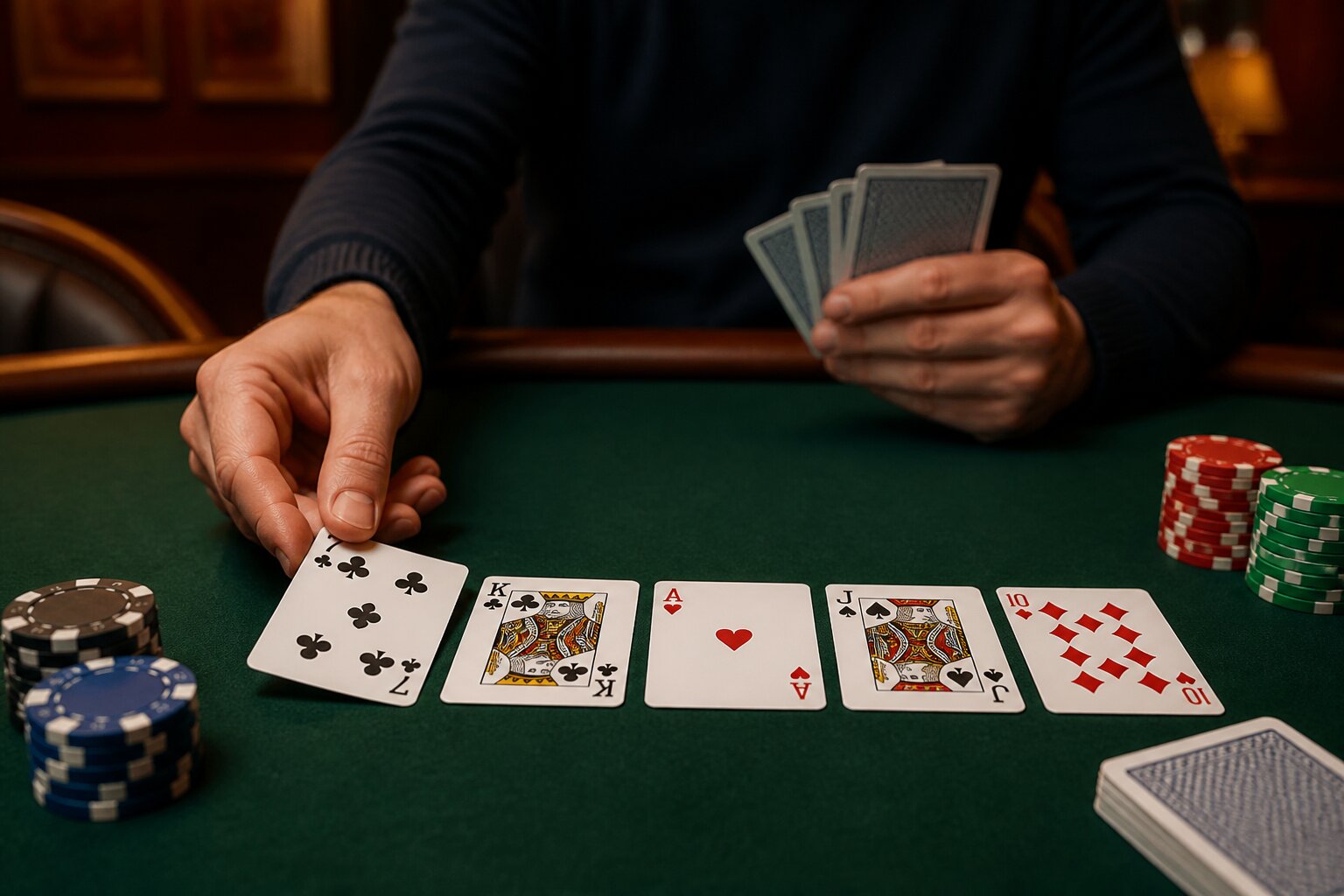
If you’re curious about classic poker games, you’ve likely heard of 5 Card Draw. Known for its straightforward rules and moments of tense decision-making, it’s a popular first stop for new players and a familiar test for regulars.
Ready to brush up on your skills or finally learn how to play properly? This guide covers the rules, the flow of play and practical tips to help you feel confident at the table.
Whether you want to impress friends at poker night or enjoy a straightforward game online, keep reading — the essentials of 5 Card Draw are just ahead.
What Is 5 Card Draw Poker?
5 Card Draw is a traditional poker variant where each player receives five cards and has one opportunity to exchange any number of them. The simplicity of the format makes it easy to follow: deal, a round of betting, the draw, a final betting round and then a showdown.
Because there is only one draw, decisions about which cards to replace and how much to commit in betting are especially important. That pressure to make each choice count is part of the game’s appeal.
You’ll find 5 Card Draw played casually at home and at online tables. Its straightforward structure makes it a useful foundation for learning other poker variants.
How Do You Deal and Play 5 Card Draw?
At the start, each player receives five cards dealt face down. A typical table has two to six players. The dealer position rotates clockwise so everyone takes turns dealing.
After the deal the first round of betting occurs. Players act in turn and may call, raise or fold. Betting sets the tone for how the rest of the hand will play out — cautious early action can conceal strength, while an early raise may pressure opponents.
Next comes the draw. Players can discard any number of their cards and receive replacements from the dealer, usually dealt one at a time beginning with the player on the dealer’s left. Some players choose to stand pat and keep their original five cards if they are satisfied with them.
Once drawing is complete, there is a final betting round. Remaining players then reveal their hands and the best hand wins the pot according to standard poker hand rankings.
What Are the Core Rules of 5 Card Draw Poker?
The game uses a standard 52-card deck without jokers. Each player receives exactly five cards, all dealt face down. After the deal, play proceeds through the two betting rounds separated by the draw phase.
Dealers distribute replacement cards during the draw and will not give more replacements than there are cards left in the deck. The player with the highest-ranking five-card hand at showdown collects the pot. Hand rankings run from high card up to royal flush and are the same as in most other poker variants.
Game conduct and agreements about stakes should be settled before play begins so everyone understands the limits and format in use.
How Do The Betting Rounds Work in 5 Card Draw?
The previous section described the sequence of play; here we focus on typical betting patterns and what they mean during those two rounds. In many home games the format is fixed-limit: small bets in the first round and larger, fixed raises in the second. Other venues may use pot-limit or no-limit structures, each changing how aggressively players can act.
In the first round, early position players must decide without seeing others’ reactions, while later positions benefit from more information. That positional advantage carries through to the second round, where knowledge of opponents’ actions and how many cards they drew will influence choices.
Betting behaviour can be informative: a player who draws one card may signal a different hand type from someone who draws three, and a sudden increase in aggression on the final round often represents a significant improvement. Reading these patterns and adjusting your responses is a key part of strategic play.
Are There Any Common Myths About Playing 5 Card Draw?
Some players think there is a guaranteed method to win every time, but no strategy ensures success. The cards you and your opponents receive, together with the decisions made at the table, create outcomes that vary from hand to hand. Even strong long-term play cannot eliminate short-term unpredictability.
Another frequent assumption is that experienced players can always tell what opponents hold. While observing patterns, betting behaviour and physical tells can provide useful clues, certainty is rare. Reading play is about making better-informed guesses, not obtaining perfect knowledge.
Other misleading beliefs include:
- Certain seats at the table are inherently better than others. In reality, position matters in poker, but each seat has advantages and disadvantages that depend on the situation rather than being universally superior.
- Past results affect future outcomes. Every deal is independent, so previous wins or losses do not change the odds of the next hand.
- Superstitions such as lucky chips or rituals changing your luck. These may provide psychological comfort, but they do not influence the mathematical chances of the game.
Understanding these misconceptions helps prevent overconfidence and distraction. Focusing on sound decision-making, studying fundamentals such as hand selection and pot odds, and observing opponents thoughtfully will improve your play more than chasing mythical shortcuts.
Remember that gambling involves risk. Only play with money you can afford to lose and consider setting limits on time and spend.
Essential Poker Hand Rankings for 5 Card Draw
Hand rankings determine the winner at showdown, so it helps to be comfortable with them. From strongest to weakest they are:
Royal Flush
A, K, Q, J, 10 all in the same suit.
Straight Flush
Five sequential cards of the same suit, for example 7, 8, 9, 10, J of hearts.
Four of a Kind
Four cards of the same rank, such as four 9s. If two players have four of a kind, the higher quads win; if those are equal, the remaining card, known as the kicker, decides the outcome.
Full House
Three of one rank and two of another, for example three 8s and two kings. When comparing full houses, the rank of the three of a kind takes priority, then the pair.
Flush
Any five cards of the same suit that are not sequential. If two players have a flush, the highest card in each flush is compared; if those are the same, the next highest cards are compared in turn.
Straight
Five cards in sequence not all in the same suit. The ace can count as high (above a king) or low (below a two) but cannot be both within the same sequence.
Three of a Kind
Three cards of the same rank, like three 5s. When two players have three of a kind, the higher trips win; if those are equal, the kickers are used to break the tie.
Two Pair
Two cards of one rank and two cards of another, plus a fifth card. Two pair hands are compared by the rank of the higher pair first, then the lower pair, and finally the kicker if needed.
One Pair
Two cards of the same rank and three unrelated cards. Pairs are compared by the rank of the pair, then by the highest remaining cards in descending order.
High Card
When no other hand is made, the highest single card determines the winner. If the highest cards are equal, compare the next highest cards in turn until a difference is found.
Understanding these rankings and the usual tie-break rules lets you evaluate how strong a hand is and how much to invest in it during the betting rounds.
Can You Play 5 Card Draw Online in the UK?
Yes — online platforms offer 5 Card Draw for adult players in the UK. Licensed operators must meet the regulatory standards set by the UK Gambling Commission, which includes age and identity verification to ensure only those aged 18 and over can play, plus measures to promote fair play and prevent underage gambling.
Operators are also required to demonstrate game fairness, typically through independent testing or certified random number generators, and to publish licence details and terms and conditions for transparency. Before registering, check a site’s licence number and operator name and consult the terms on game rules, withdrawal times and bonus conditions.
Most sites provide tools to help players manage their activity, such as:
- deposit limits to control how much you put on the account,
- time-outs that allow short breaks from play,
- self-exclusion options for longer or permanent breaks.
Make use of these controls and consider contacting the operator’s customer support if you have questions about responsible gambling features. If you believe you have a gambling problem, seek help promptly from UK support services such as GamCare or register with the national self-exclusion scheme, GamStop.
Tips for Hosting a Home 5 Card Draw Poker Game
A home game should be relaxed and clearly organised so everyone enjoys the evening. Start with a few basic agreements: confirm all players are 18 or over, agree the stakes and clarify that the game is private and not run for profit.
Keep bets small and transparent to avoid misunderstandings, and provide breaks so the atmosphere stays friendly. Avoid charging fees or taking a cut of wagers — private games should stay within legal boundaries.
Encourage fair conduct and considerate behaviour at the table, and make sure anyone who feels uncomfortable can stop playing without pressure. A well-run night focuses on good company and clean play rather than competition alone.
Final note: whether you’re learning the rules, planning a friendly night in, or trying a few hands online, 5 Card Draw rewards careful choices and attention to how others play. Enjoy the game and play within limits so the experience stays positive for everyone.
**The information provided in this blog is intended for educational purposes and should not be construed as betting advice or a guarantee of success. Always gamble responsibly.