
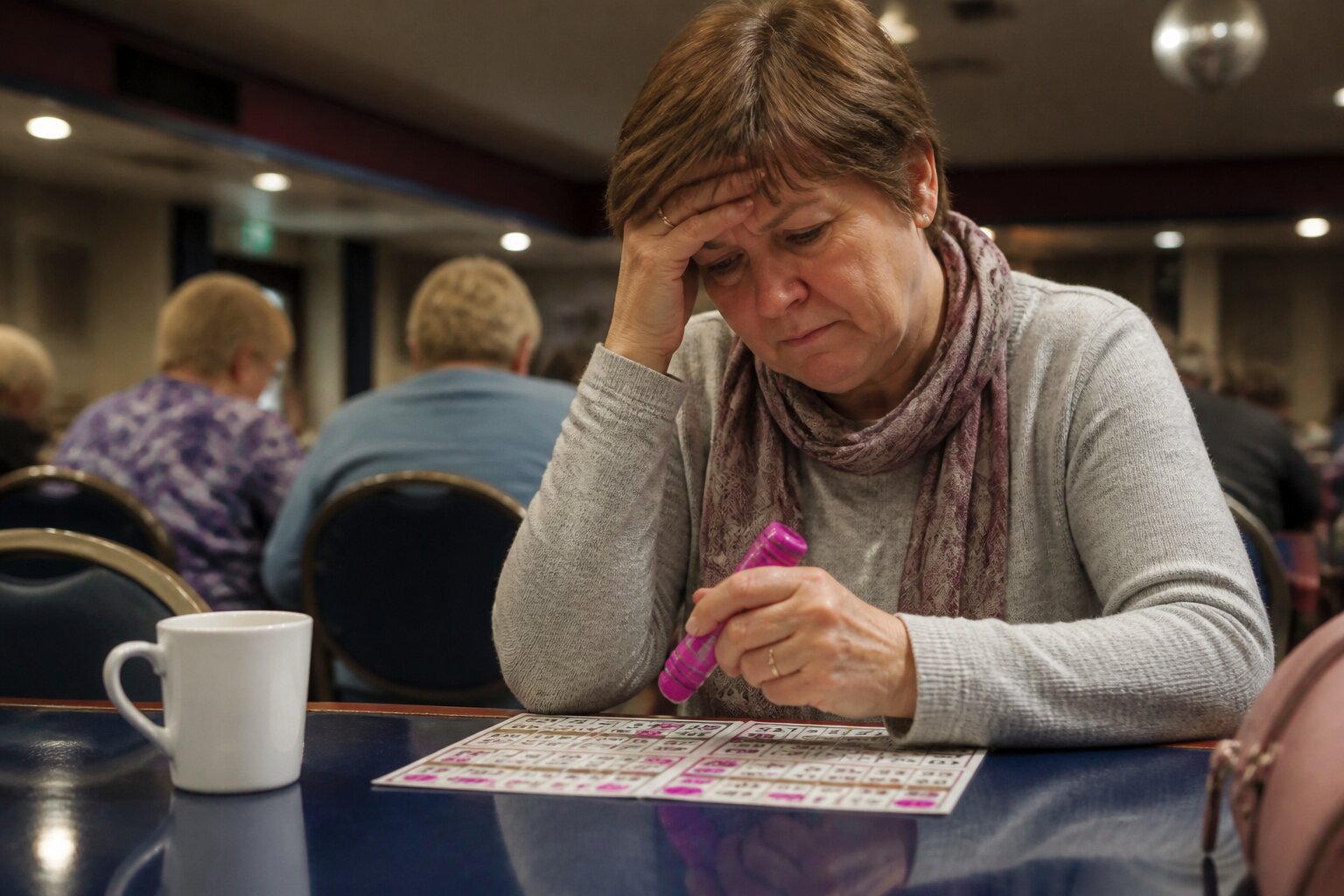
Ever found yourself at the end of a bingo game, marker in hand, asking, “Why do I never win at bingo?” You’re not alone—many players wonder the same thing, whether they’re new to the game or seasoned regulars.
When you see others shout “Bingo!” while your card remains frustratingly incomplete, it’s natural to search for an explanation. Is it skill, strategy, or the way the game is run that determines the outcome?
This post explains how bingo is organised, the real odds behind wins, and the common reasons some players win more often than others. Read on to get a clear picture of what influences results and what you can realistically expect.
Understanding How Bingo Works
Bingo is simple in its structure: players buy tickets showing a grid of numbers, numbers are drawn at random, and players mark any matches on their tickets. In 90-ball bingo, a typical ticket in the UK has three rows and nine columns, with five numbers per row. A 75-ball game uses a 5x5 grid and different winning patterns.
The aim is to complete a specific pattern such as a single line, two lines, or a full house, and the first ticket to do so wins the round. Because every number drawn comes from the same pool and each ticket’s numbers are assigned without influence, no particular ticket or play style can reliably change your chance of winning. This makes it important to understand how randomness and ticket counts shape outcomes as you consider where to play next.
Are Bingo Games Really Random?
Yes. In traditional halls, balls are mixed in a drum and selected one by one so no pattern can be predicted. Online, Random Number Generators (RNGs) perform the same role digitally, ensuring each draw is unpredictable and unbiased. Independent testing and certification check that these systems work correctly and do not favour any player or ticket.
Regulation means results are genuine and cannot be fixed, which protects everyone taking part. Given that, what differs between games is not fairness but scale: the number of tickets in play and the format of the game. Understanding this leads naturally into looking at the actual odds you face in any given session.
What Are the Odds of Winning at Bingo?
Odds in bingo are determined by the share of total tickets you hold. If 100 tickets are in play and you own one, your chance of winning that round is 1 in 100, or 1%. Own five tickets and your chance becomes 5 in 100, or 5%. The relationship is direct and mathematical: more tickets equal a larger share of the pool, but no certainty.
In a small hall where 50 players hold roughly two tickets each, there might be about 100 tickets total; owning two tickets gives you 2% odds. In an online room with 500 tickets, a single ticket gives a 0.2% chance. Different winning patterns — a single line versus a full house — don’t change the per-ticket probability of being the first to complete that pattern, since every draw treats each ticket equally.
With a clearer sense of the maths, it’s helpful to look at the practical reasons winning can still feel rare.
Common Reasons You Might Not Win
Many factors behind repeated losses are structural rather than personal: the number of players, the game variant, and players’ expectations all play a part. Below are the main reasons wins can seem infrequent.
The Impact of Player Numbers
The size of the player pool has the largest effect on your odds. Fewer tickets in play means each ticket represents a larger slice of the chance to win, while big rooms reduce individual shares. A game with 10 tickets gives a single ticket a 10% chance; a game with 1,000 tickets reduces that single-ticket chance to 0.1%. High participation in online rooms often explains why wins feel scarce compared with smaller local sessions. This leads naturally into why ideas about “special” tickets don’t hold up.
Misconceptions About Bingo Patterns
Some players think certain number layouts or visual patterns make a ticket more likely to win, but that’s not supported by how the game is run. Numbers are assigned and drawn without bias, so the shape or sequence on a ticket does not improve its chance of completing a required pattern. Treating a ticket as inherently “better” simply misunderstands how randomness and ticket distribution work. With that cleared up, it’s worth considering how different game types change the pace and the number of opportunities to win.
The Role of Game Variants
Variants affect tempo and prize structure, which changes the player experience. A 90-ball game requiring a full house usually lasts longer and gives more opportunity for multiple winners across different rounds, while a 75-ball game with a single-row win will end faster and produce winners more quickly. These differences change how often you might see a win, but they don’t alter the underlying probability for each ticket. Being aware of variant formats helps set realistic expectations about how many games you might win in a session.
Do Bingo Myths Influence Players' Expectations?
Myths about “hot” tickets, special seating, or ideal play times persist because humans like patterns and control. Believing a ticket is inherently luckier or that external factors like seat location matter can lead to disappointment when results don’t match expectations. Since games are independently checked and draws are random, such beliefs offer no real advantage.
Recognising myths for what they are can make the game more enjoyable: it shifts focus from chasing imagined edges to appreciating the social and entertainment aspects of bingo. With superstition out of the way, it becomes clearer how practical choices — such as how many tickets to buy or which game format to play — actually influence results.
Can Playing More Tickets Improve Your Chances?
Holding more tickets increases your mathematical share of the tickets in play, so buying additional tickets raises your chance of winning a specific round. For example, owning 10 of 100 tickets gives a 10% chance. That said, a higher chance is still not a guarantee, and the cost of more tickets can quickly outweigh the reward if budget isn’t managed.
Balancing ticket spend against expected returns is sensible: decide in advance how much you are willing to spend on a session and keep to it. This approach keeps the activity sustainable and helps ensure it remains an enjoyable pastime rather than a source of stress. Thinking about money in this way ties together the practical points above and brings the discussion to a close with a clear takeaway: know the odds, choose formats that suit you, and play within sensible limits for a better experience overall.
Play Casino Games Online at Money Reels
We’d love to welcome you to our site, where you can enjoy playing casino games in a fun and friendly setting. Whether you’re new to casino gaming or an experienced player, everyone is invited to join us and explore what’s on offer.
Getting started is straightforward – simply create an account, make a deposit, and you’re ready to play. We look forward to seeing you at Money Reels.
**The information provided in this blog is intended for educational purposes and should not be construed as betting advice or a guarantee of success. Always gamble responsibly.