
Have you ever watched the ball land on the same roulette number twice and wondered how rare that really is? Or noticed repeat patterns during play and questioned whether there’s any order behind them?
Roulette is full of surprising outcomes, and the odds behind those repeats are often misunderstood. This article lays out the straightforward probability behind repeated numbers, explains why patterns are not predictive, and looks at how modern games are kept fair and random. Read on to see the wheel in a clearer light.
Understanding Roulette and Number Outcomes
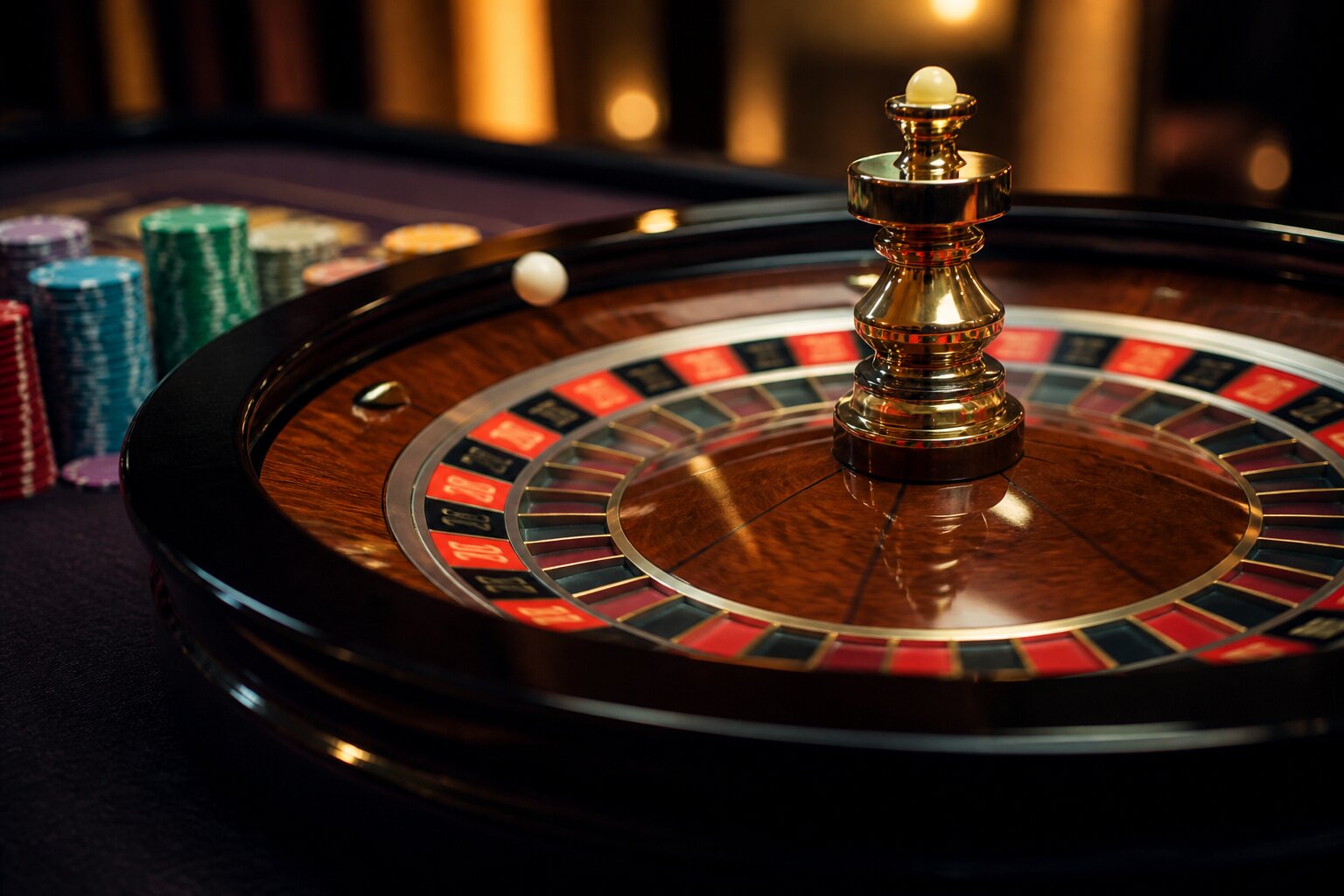
Roulette centres on a spinning wheel and a small ball that drops into one of the numbered pockets. Each spin is an independent event: the result of one spin does not change the odds on the next. Two common wheel types are used: the European wheel with 37 pockets numbered 1 to 36 plus a single green zero, and the American wheel with 38 pockets, which adds a green double zero. The extra pocket on the American wheel makes the house edge slightly higher.
Every pocket on a correctly maintained wheel has the same chance of receiving the ball on any single spin. Casinos and online operators must use equipment and systems that are tested to ensure outcomes are fair and random. Understanding this independence is the foundation for the probability calculations that follow, so next we will look at the specific odds of the same number appearing more than once.
What Are the Odds of the Same Number Repeating in Roulette?
The maths for repeats is simple to follow. On a European wheel any specific number has a 1 in 37 chance on a single spin, which is about 2.70 per cent. On an American wheel the chance is 1 in 38, roughly 2.63 per cent. To find the probability of the same number coming up twice in a row, multiply the single-spin probability by itself. That gives 1 in 1,369, or 0.073 per cent, on a European wheel, and 1 in 1,444, or 0.069 per cent, on an American wheel.
Extending that to three consecutive repeats makes the probability tiny. On a European wheel the chance for the same number three times is 1 in 50,653, or about 0.002 per cent; on an American wheel it is 1 in 54,872. These figures illustrate how quickly probabilities fall when events must happen several times in sequence. With that in mind, the next section explores how often such repeats occur in practice and what influences how players perceive them.
Repeat Patterns: How Often Do Numbers Come Up Again?
Repeats such as the same number appearing twice or three times consecutively are striking when they occur, but they are genuinely uncommon. The number of pockets on the wheel is the primary factor: fewer pockets mean slightly higher odds for any specific repeat, so repeats are fractionally more likely on a European wheel than on an American one. How many spins are observed also matters; the more spins you watch, the more likely you are to encounter an unusual sequence simply by chance. Finally, human perception plays a role. People are naturally good at spotting and remembering striking coincidences, so repeat patterns tend to stick in the memory even though they remain rare overall.
To put the difference between wheel types into words rather than a table: a repeat of the same number twice in a row happens with a probability of about 1 in 1,369 on a European wheel and about 1 in 1,444 on an American wheel. For three repeats the figures are roughly 1 in 50,653 and 1 in 54,872 respectively. These numbers show that while repeats do happen, they are statistical outliers rather than indicators of a trend. With that context, it is useful to look at common misconceptions about how probability works in roulette.
Probability Myths vs Reality in Roulette
Several persistent myths surround roulette. One is the idea that numbers become "hot" if they have appeared frequently, or "cold" if they have not come up recently. Another is the gambler’s fallacy, the belief that an outcome is more likely because it has not occurred for some time. Both of these notions confuse correlation with causation. In a fair game each spin remains independent, so no number gains or loses probability through past results.
People also interpret streaks as meaningful when they are often just natural fluctuations within random sequences. Noticing a run of the same colour or repeated numbers is not evidence that the sequence will continue or that it must stop. Recognising these errors in thinking helps set realistic expectations about what the numbers actually tell you. The next section examines why previous spins do not exert any influence on future outcomes.
Can Previous Spins Influence Future Outcomes?
The straightforward answer is no. In roulette a prior result does not affect the next spin. Probability theory and the mechanics of a fair wheel or correctly implemented random number generator mean every spin starts with the same set of odds. So if a particular number appears three times in a row, the chance of it appearing on the following spin remains the single-spin probability for that wheel.
Beliefs that a number is less likely immediately after it has landed or that a number is overdue are instances of the same misconceptions discussed earlier. These ideas do not reflect how chance operates in this game. Accepting the independence of spins also helps when considering how operators ensure consistent fairness, which is what the following section covers.
Randomness and Fairness in Modern Roulette Wheels
Fairness in roulette is maintained through a combination of precise manufacturing, routine checks, and, for online play, certified random number generation. Physical wheels are produced with tight tolerances so pockets are uniform, and venues carry out regular maintenance and inspections to avoid any mechanical bias. Online games use RNGs that are independently tested and certified to produce outcomes that mirror the uniform probabilities of a physical wheel.
Regulators require operators to meet these standards and subject games and equipment to audits. Where issues are found, those operators face penalties or corrective action. These safeguards mean that both in-person and online players can expect spins to be random and impartial. With an understanding of the mechanics and the rarity of repeated numbers, readers can now see why occasional streaks are memorable but not predictive, and how the game’s structure keeps it fair.
This overview should leave you with a clear sense of how improbable repeated numbers are, why apparent patterns do not indicate future results, and how fairness in roulette is practically enforced.
Play Casino Games Online at Money Reels
We're delighted to welcome you to our site, where you can experience the excitement of casino gaming in a relaxed and friendly setting. At Money Reels, we pride ourselves on offering a welcoming environment for everyone who loves to play.
Getting started couldn’t be simpler—just create your account, make a deposit, and you’ll be ready to explore all we have to offer. We’re here if you need us, and we hope you enjoy your time with us.
**The information provided in this blog is intended for educational purposes and should not be construed as betting advice or a guarantee of success. Always gamble responsibly.