
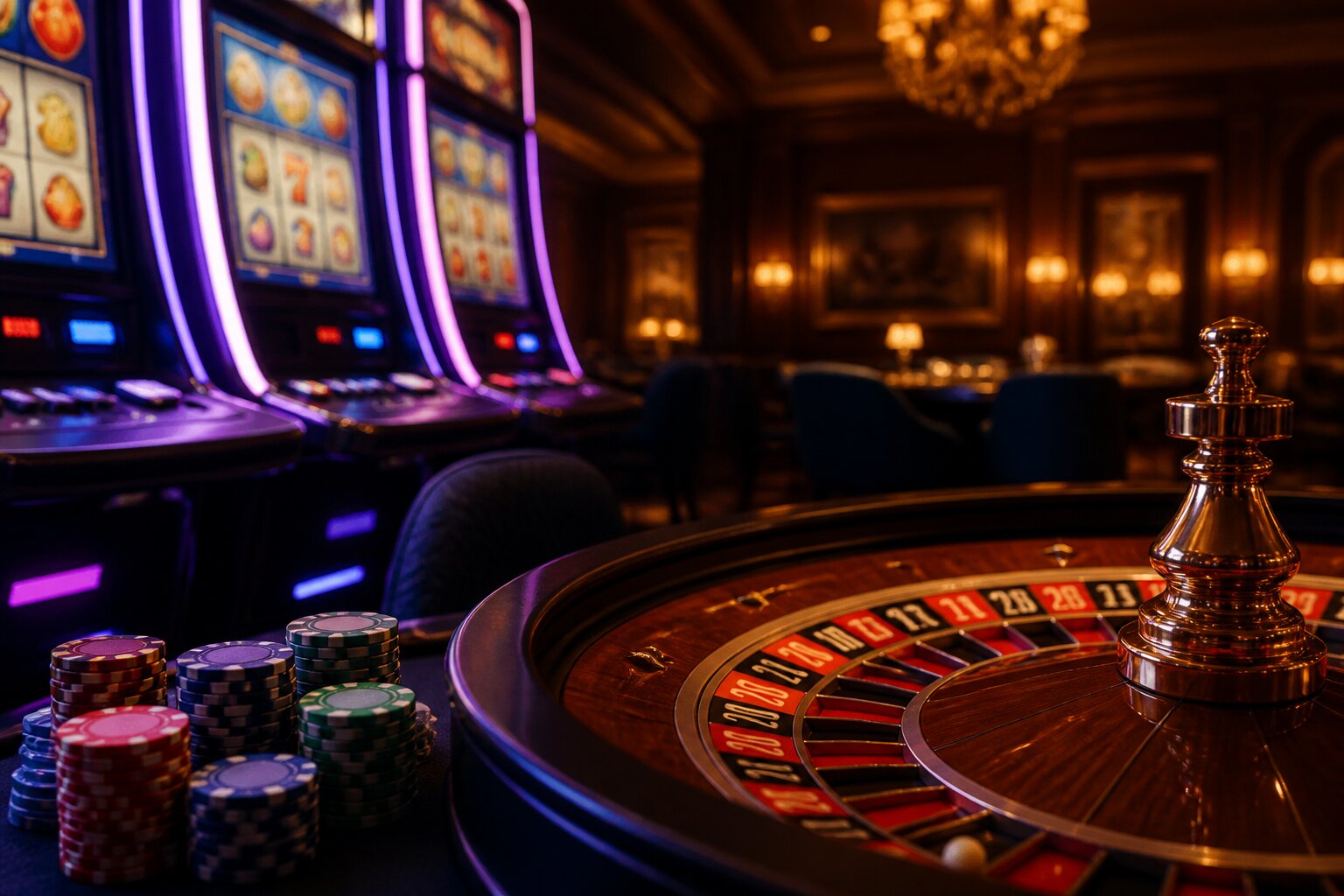
Thinking about whether to head for the slot machines or the roulette table? You’re not alone.
Both offer excitement, bright lights and the possibility of a big win, but they deliver very different experiences, odds and styles of play. This guide explains what makes each game distinct, how the odds work, and which might suit you best—so you can make a clearer choice before you spin the reels or place your chips.
What Are Slot Machines & Roulette?
Slot machines are electronic games found in casinos and online platforms. You place a stake, trigger a spin, and the reels stop to display a combination of symbols. If the symbols match a winning pattern, the machine pays out according to its rules. Modern slots come with varied themes, bonus features and different ways to win.
Roulette is a table game where players bet on where a small ball will land on a spinning wheel. The wheel has numbered pockets, usually coloured red or black, plus one or two green zero pockets depending on the variant. Bets can cover single numbers, groups of numbers, colours or ranges, and the dealer spins the wheel before announcing the result.
Both types of game are regulated, and players must meet the minimum legal age to take part. It’s important to approach either game as entertainment rather than a source of income.
How Do Slot Machines Work Compared to Roulette?
Slot machines and roulette both produce outcomes that players cannot control, but they do so in different ways.
Slots use a computer programme called a random number generator (RNG) to determine each spin. The RNG produces a number that corresponds to a reel position, so every spin is an independent event. This means previous spins do not affect future ones, and the odds for a given symbol combination are fixed by the game’s design.
Roulette outcomes on a physical wheel are governed by the motion of the wheel and ball; online versions use an RNG applied to a digital wheel instead. Bets are placed on where the ball will come to rest, and the pay-outs are determined by the type of bet chosen. While roulette gives players many betting options, the mathematical probabilities behind each bet stay constant from spin to spin.
In both cases the house sets the long-term advantage, but the mechanics—electronic combinations for slots versus wheel physics or RNG-decided wheel outcomes for roulette—shape how each game feels and plays.
What Are the Main Differences Between Slot Machines and Roulette?
Several clear differences separate the two games.
Play style and mechanics differ: slots are typically single-player experiences on a machine or device, with results generated by the game software. Roulette is usually played at a table where multiple people place bets and watch the same outcome.
Decision-making varies, too. Slots require only a stake and a spin, with any additional decisions linked to optional bonus features inside the game. Roulette offers a wider range of betting choices—inside bets on single numbers, outside bets on colours or ranges—and those choices affect the pay-out and probability of winning.
The tempo and atmosphere contrast as well. Slots tend to run quickly, with repeat plays available immediately. Roulette moves at a steadier pace, allowing time for discussion and strategy around different bets.
Finally, the visual and social elements differ: slots often use graphics and sounds to engage the player, while roulette centres on the physical wheel and a shared table environment.
Understanding the Odds: Slot Machines vs Roulette
Every play in either game is influenced by the odds built into the game. Over time, those odds determine the proportion of stakes returned to players and the portion retained by the house.
For slots, the key measure is RTP (Return to Player). RTP is expressed as a percentage and represents the theoretical average amount a game will return to players over a very large number of spins. For example, an RTP of 96% suggests that, on average, £96 of every £100 wagered is returned to players, while £4 represents the house’s long-term share. RTP varies by game and is determined by the game’s design and pay tables.
Roulette’s advantage is expressed as the house edge and depends on the variant. European roulette, with a single zero, carries a house edge of about 2.7%. American roulette, which includes an extra zero, has a higher house edge of around 5.26%. Different bets on the roulette table also have different probabilities and payouts: a straight number bet offers a large payout but a small probability of success, while outside bets (such as colours or even/odd) pay less but win more frequently.
Knowing these figures helps set expectations: RTP and house edge describe long-term averages, not guaranteed returns on any particular session.
House Edge Explained
The house edge shows the proportion of each stake that the operator expects to keep over time. For slots this is reflected through RTP; for roulette it’s a fixed percentage according to the wheel layout. Both measures are statistical and become meaningful only across many plays. Short sessions can produce a wide range of results that deviate from the theoretical averages.
Which Game Offers a Better Player Experience?
The “better” experience depends on what you want from play: visual stimulation, social interaction, game speed or the variety of betting choices.
Visual and sound design often define the slot experience. Many slots use detailed artwork, animations and soundtracks to create themes such as adventure, history or film tie-ins. Bonus rounds and special features add variety so sessions can feel different from spin to spin.
Roulette focuses attention on the wheel and the outcome it produces. In land-based settings the mechanical act of the dealer spinning the wheel creates a ritual that many players enjoy. Live-dealer online roulette replicates that presence while allowing players to place a wide range of bets and observe the table dynamics.
Social interaction is a further contrast. Slots are largely solitary, even when played in a casino among other machines; roulette naturally brings people together around the same result, encouraging conversation and shared moments.
Pace matters too. Slots allow rapid repeat plays and suit those who prefer continuous action. Roulette’s rhythm is more measured, with pauses for bet placement and a single decisive result each round, which can build suspense in a different way.
If you value immersion and varied gameplay, slots may appeal. If you prefer a social table game with a range of strategic betting choices, roulette is a strong option.
Are There Any Common Myths About Slot Machines and Roulette?
Several persistent ideas about these games don’t match how they actually operate.
One myth is that slot machines are “due” to pay after a dry spell. Because slots use an RNG, every spin is statistically independent; prior spins do not make a win more or less likely on the next play.
A similar belief exists in roulette, where players sometimes think numbers or colours can be streaks that will continue. Each spin is separate, and the probabilities associated with each type of bet remain the same regardless of earlier outcomes.
Another misconception is the existence of foolproof systems that guarantee wins. While some betting patterns can manage stake size or variance, none can alter the built-in mathematical advantage that the house holds over time.
Spotting these misunderstandings helps set realistic expectations and makes sessions more enjoyable.
Which Game Should You Choose?
Choosing between slots and roulette comes down to the experience you want and how you plan to manage your play. If you prefer immediate, varied gameplay with visual and audio features, slots provide that. If you enjoy social play, a wider set of betting choices and a measured pace, roulette might be more satisfying.
Keep in mind the statistical realities: RTP for slots and the house edge for roulette describe long-term trends rather than short-term outcomes. Decide what feels entertaining for you, set sensible limits and take breaks when needed. If gambling ever becomes a concern, support is available from recognised organisations.
Whichever you try, approach the game with clear expectations, enjoy the experience on its own terms, and play within your means.
**The information provided in this blog is intended for educational purposes and should not be construed as betting advice or a guarantee of success. Always gamble responsibly.