
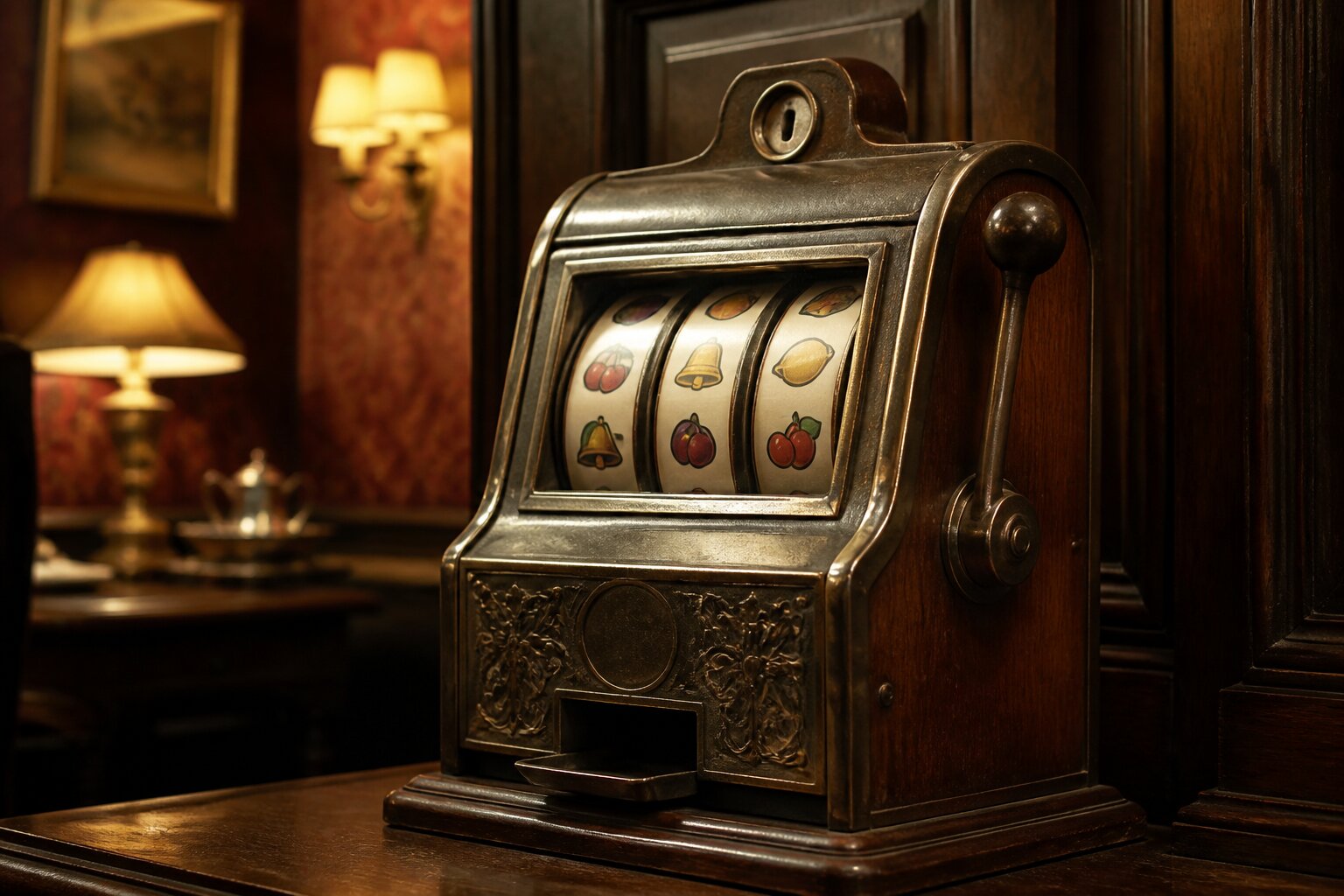
Have you ever wondered how slot machines first came to be? These spin-and-win favourites have come a long way from their humble beginnings and now appear across casinos and online sites.
The journey from the very first slot machine to the modern video slots we know today is full of inventive engineering and changing technology. It’s a history that helps explain why contemporary games look and behave the way they do.
Curious where it all began and which moments mattered most? Let’s take a spin through the milestones that shaped slot machines, from simple mechanics to complex digital systems.
What Defines a Slot Machine?
A slot machine is a gambling device where a player places a wager and spins reels that display symbols. The goal is to match certain symbols along a payline to earn a payout.
Early models were entirely mechanical slots. A lever set gears and springs in motion and the reels bore painted symbols that lined up by chance. Today most machines are electronic or digital, with computer software and screens replacing many moving parts. Random Number Generators, or RNGs, now determine every spin’s result to ensure fairness and unpredictability.
Players use money or ticket credits to set bets and spin. Machines appear only in regulated venues or on licensed online sites, and UK players must be 18 or over to take part. Keep this in mind as you explore the rest of the history.
How Did Early Slot Machines Work?
The first slot machines relied on purely mechanical engineering. Inserted coins triggered a lever, which released a spring and set a cluster of gears and reels rotating. Each reel carried symbols painted on its surface, and internal mechanisms checked those symbols as the reels stopped. If the symbols aligned on a payline, the mechanism opened a coin chute to deliver a payout.
Those early designs limited the number of symbols and payout possibilities, because everything depended on physical parts and precise alignment. Their simplicity made them popular in pubs and shops, but it also invited evolving regulation about where they could be installed and how they should operate.
Who Developed the First Slot Machine?
Charles Fey, a mechanic in San Francisco, built the most famous early machine in 1895. Born in Bavaria in 1862, Fey emigrated to the United States and worked on mechanical devices before turning his attention to gambling machines. His model, known as the Liberty Bell, used three spinning reels and simple symbols such as horseshoes, stars and bells. The highest return came from three bell symbols in a row, and the machine automated the payout process rather than relying on an attendant.
Fey’s work set a practical template: a compact game that delivered instant, automatic payouts. It was small enough to fit on a bar counter, rugged enough for heavy use, and straightforward for players to understand. The Liberty Bell soon became popular in saloons and other social venues, influencing both the public’s expectations and other inventors’ designs.
Subsequent inventors built on that template, adding features and safety improvements while keeping the core idea of spinning reels and matching symbols. Typical developments included:
- improved coin acceptance mechanisms to reduce jams and fraud
- more reliable automatic payout systems so machines could operate unattended
- stronger locks and tamper-resistant cabinets for security
- additional reels and more varied symbol sets to create new prize combinations
- refinements to the lever and gearing for smoother, faster play
Over time these incremental changes transformed Fey’s basic concept into the diverse family of slot machines seen today, but the Liberty Bell remains recognised as the practical ancestor of modern mechanical slots.
How Have Slot Machines Changed Over Time?
Slot machines evolved in step with available technology. Electromechanical models in the 1960s brought electric circuits to aid reliability and more consistent payouts. The 1980s introduced video slots, where screens replaced physical reels and software opened the door to varied symbols, bonus features and more elaborate game mechanics.
The internet and mobile devices then made slots accessible outside physical venues. Software development allowed designers to layer themes, animations and bonus rounds onto the basic reel-and-payline structure. Regulation and testing procedures adapted too, with independent checks on RNGs and other safeguards to ensure games meet fairness standards.
Those shifts changed not only how games look but how players interact with them, expanding the ways people experience the same fundamental mechanics first seen in Fey’s machine.
What Role Did Slot Machines Play in Popular Culture?
Slot machines have been a recurring visual shorthand for gaming and casinos in film and TV. Their imagery — flashing lights and spinning reels — often signals a gambling setting and appears in movies, television and advertising.
Artists and designers have also borrowed their symbols and forms, so fruit symbols, bells and bar symbols show up in fashion, graphic design and illustration. In local communities, particularly in seaside towns and arcades, machines contributed to leisure culture and became a familiar sight beyond casinos.
Cultural presence helped normalise the machines’ imagery, but that does not mean everyone should play. Decisions about gambling belong to individuals and should be informed by clear information about how games work.
How Have Slot Machines Evolved Digitally?
The arrival of online casinos converted physical slot mechanics into software-based games playable on desktop and mobile devices. Developers recreated the reel-and-symbol logic in code while adding varied themes, animations and bonus mechanics that were impossible with purely mechanical designs.
Digital games still use RNGs to determine results; this is the same concept introduced earlier but implemented in software and independently audited in regulated markets. Licensed online operators must provide secure payments, transparent game information and account tools such as deposit limits and self-exclusion to help players manage their activity.
These digital controls also make it easier to check game rules, payout percentages and other essential information before playing, which aids informed decisions.
Common Myths About the Origin of Slot Machines
There are several persistent myths about where and how slot machines began. Clearing them up helps separate fact from folklore.
Myth: Slot Machines Came from Las Vegas
Because Las Vegas is strongly associated with casino gaming today, some assume slots originated there. In reality, the earliest recognisable machines were invented in San Francisco in the late 19th century, well before Las Vegas became prominent as a gambling centre.
Myth: Fruit Machines and Slot Machines Are Completely Different
Fruit machines developed a distinct style in the UK, but they are rooted in the same basic mechanics as American slot machines. The naming and cultural context differ, yet the underlying idea of spinning symbols and matching paylines is shared.
Myth: Early Slot Machines Were Made to Cheat Players
While early technology was simpler and sometimes easier to tamper with, most early machines were not deliberately designed to be unfair. Modern licensed games are subject to strict testing and regulation to protect players and ensure fair operation.
These corrections should make the origins and development of slot machines clearer. If you want to explore specific machines, themes or the technical side of modern RNG testing next, there’s plenty more to discover.
**The information provided in this blog is intended for educational purposes and should not be construed as betting advice or a guarantee of success. Always gamble responsibly.