
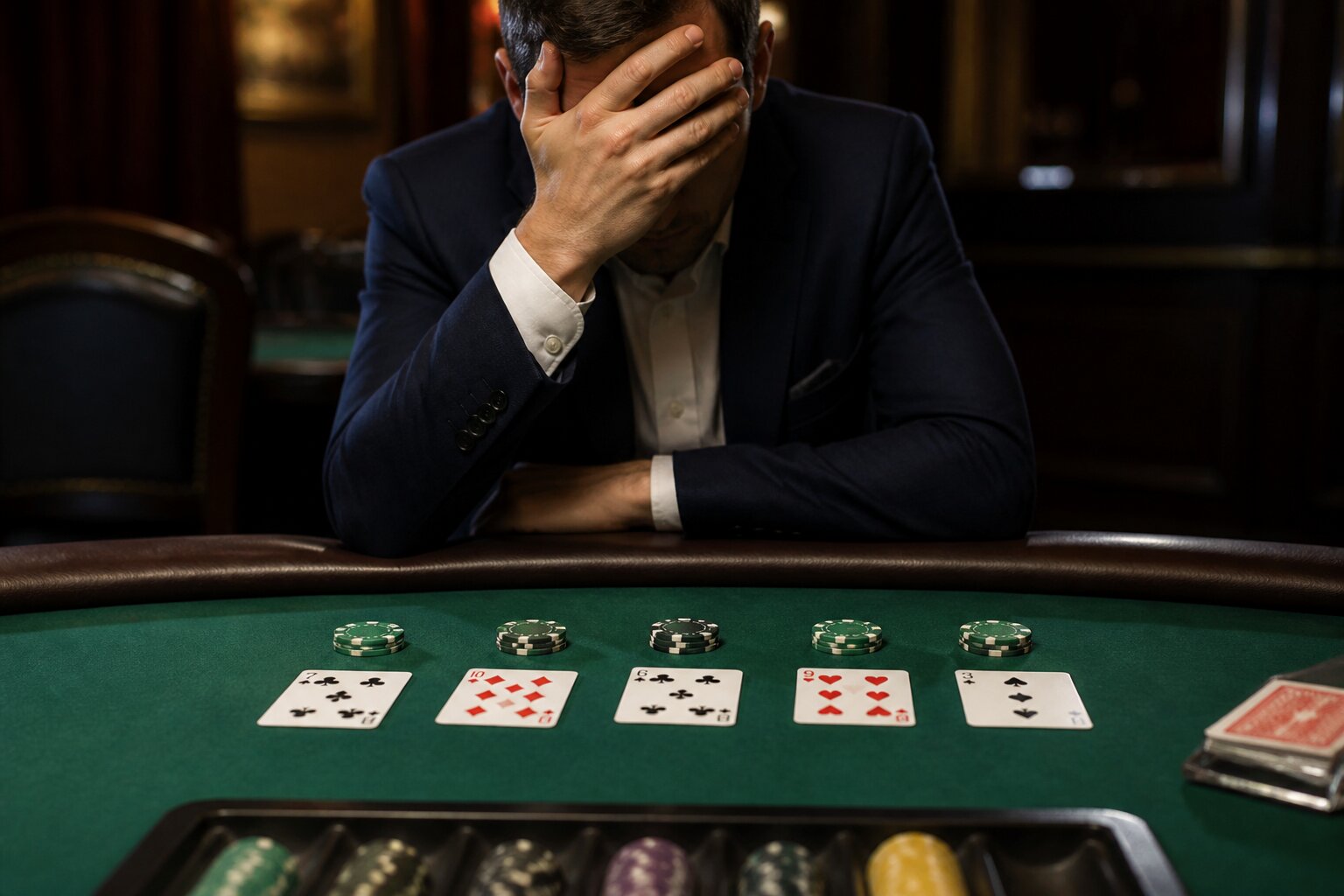
Ever wondered why those runs of losing hands at a blackjack table feel so surprising? It’s common for players to expect outcomes to balance out, only to find the same result again.
There’s a lot of talk about “hot streaks” and the idea that the odds must swing back in your favour soon. In this post, we separate myth from reality and explain the real maths behind losing streaks in blackjack.
Read on to understand the true probabilities, how rules change the picture, and how that knowledge can help you manage a session more sensibly.
Understanding Blackjack Probabilities
Blackjack mixes decision-making with randomised card draws. Each hand is an independent event: the result of one hand does not change the probabilities for the next. Under commonly used rule sets with multiple decks and basic strategy, the long‑term outcomes are well documented.
Typical single‑hand results fall roughly into these ranges when standard rules apply and basic strategy is used:
- Player win: around 42–49%
- Dealer win: around 49–55%
- Push (a draw): about 8–9%
These percentages are averages calculated over many hands. They indicate what might occur over the long run rather than predicting any single session. With that in mind, the next section explains precisely what we mean by a “losing streak” and how to count it so you can interpret those percentages correctly.
What Does “Losing X Hands in a Row” Actually Mean?
A losing streak means playing several consecutive rounds where each one ends in a loss for the player, with no wins or pushes interrupting the sequence. It is an outcome-based measure, not a statement about money won or lost overall.
For example, losing five hands in a row means five separate rounds all concluded with the dealer winning. Pushes do not count towards the streak; they break it because they are not losses. The focus is strictly on the sequence of outcomes rather than session profit and loss.
Understanding this distinction is useful when you look at how probabilities combine across hands, which is what we cover next.
Common Myths About Blackjack Losing Streaks
Misconceptions about streaks are widespread and can lead to poor choices at the table. Many players attribute meaning to short-term outcomes and change their play or stakes as a result. Below are some of the most common myths and the reality behind them.
The Gambler’s Fallacy Explained
One of the most persistent myths is the idea that after a run of losses, a win becomes more likely. This is known as the Gambler’s Fallacy. Since each hand is independent, past results do not change the underlying probabilities of the next hand. The likelihood of winning remains the same from hand to hand under identical conditions.
Believing otherwise can prompt players to increase stakes in the mistaken belief that a recovery is imminent, or to abandon basic strategy because of perceived “due” outcomes. In reality, treating each deal as a fresh event helps maintain realistic expectations and supports more considered decisions about bankroll and risk.
Can Patterns or Streaks Be Predicted?
Some players search for patterns they believe will signal the end of a run. In practice, there is no reliable method to forecast when a streak will stop. Cards are dealt in a way that produces unpredictable sequences; apparent patterns are simply the result of random sampling. No pattern-based system will consistently outguess the probabilities.
Perceiving patterns where none exist is a common human tendency. This can lead to the use of elaborate tracking or betting systems that offer no real advantage. Recognising the randomness of outcomes reduces the chance of adopting costly habits driven by false predictions.
Does Table Selection or Seat Impact Outcomes?
The seat you take or the table you pick does not alter the mathematical odds. Rule differences between tables do matter (as explained later), but the physical seat or superstition-based choices have no effect on the random distribution of cards.
Practical considerations such as table limits, dealer speed and the number of players at a table will affect the pace of play and how quickly you move through your bankroll, but they do not change the underlying chance of any particular hand. Focusing on measurable differences such as rules, minimums and table etiquette is more useful than relying on superstition.
Armed with these clarifications about common fallacies, the next section shows how to calculate the actual odds of a streak happening.
How Are Blackjack Losing Streak Odds Calculated?
Because individual hands are independent, the probability of losing several in a row is found by multiplying the single‑hand loss probability by itself for each hand in the sequence.
The general formula is:
(Probability of losing one hand) ^ (number of hands in the streak)
Using a representative single‑hand loss probability of 49% (0.49) gives an illustrative example. For five consecutive losses:
0.49^5 = 0.0285
That result corresponds to about a 2.85% chance of losing five hands in a row under those conditions. The same method applies to any length of streak: change the single‑hand probability and the exponent to match the situation. Next, we look at how table rules adjust those base probabilities, which in turn change these calculations.
Do House Rules Affect Your Chances?
Small rule variations can shift the house edge and therefore change the probability of losses over time. Payouts, number of decks, and dealer actions are the main levers that affect long‑term odds.
Payouts: A 3:2 payout for a natural blackjack returns more to the player than a 6:5 payout, so the latter increases the house advantage.
Deck count: Single‑deck games typically give the player a slight improvement in odds compared with multi‑deck games. More decks generally raise the house edge.
Dealer behaviour and player options: Whether the dealer hits or stands on soft 17, the rules on doubling after splits, surrender options, and how many times you can split pairs all shift expected outcomes to varying degrees.
Because every rule tweak alters the single‑hand probabilities, it also alters the calculated chance of a losing streak. Knowing the rules at a table therefore helps you estimate the realistic likelihood of extended runs of losses.
Is it Possible to Avoid Extended Losing Streaks?
There is no way to remove the risk of multiple consecutive losses entirely. Since outcomes are random, even optimal decision‑making cannot guarantee avoidance of losing runs. What strategy and good practice can do is reduce the house edge and help manage the financial and emotional impact of losing sequences.
Basic strategy reduces the house advantage by guiding choices that produce the best expected outcome for any hand total and dealer upcard. Bankroll management limits exposure by defining how much is affordable to lose in a session, breaking play into manageable bets and avoiding escalation after setbacks. Setting bet size, session limits, and taking breaks are practical measures that keep play within personal boundaries and reduce the chance of sustained harm.
These approaches do not change the odds themselves, but they alter how losses affect a player’s session, which is the practical aim for most people. The next section describes the kinds of effects losing streaks have on the playing experience and behaviour.
The Impact of Streaks on Your Playing Experience
Extended runs of losses can influence decision‑making and mood, sometimes prompting players to increase stakes in an attempt to recover. That response typically increases exposure and can magnify losses rather than correct them.
Emotionally, strings of defeats can cause frustration and impatience. Those feelings often lead to choices that deviate from sound play, such as abandoning basic strategy or changing bet sizes impulsively. Recognising these signals—irritation, excessive focus on recouping losses, or a loss of enjoyment—can indicate that it’s time to step away.
Keeping perspective helps preserve the recreational value of blackjack. Accepting that probability allows streaks to occur, while using sensible bankroll limits and clear stopping points, makes sessions more sustainable and prevents an emotional spiral when outcomes turn against you. With that in mind, consider your own limits before playing and stick to them.
This wraps up the discussion on odds, common misconceptions, rule effects, and practical responses to losing sequences, giving you a clearer picture of what to expect when you play.
Enjoy Casino Games at Money Reels
At Money Reels, you’ll find a friendly place to unwind and enjoy playing online casino games at your own pace. We’ve created a laid-back experience where you can settle in and discover all that we have to offer.
**The information provided in this blog is intended for educational purposes and should not be construed as betting advice or a guarantee of success. Always gamble responsibly.