
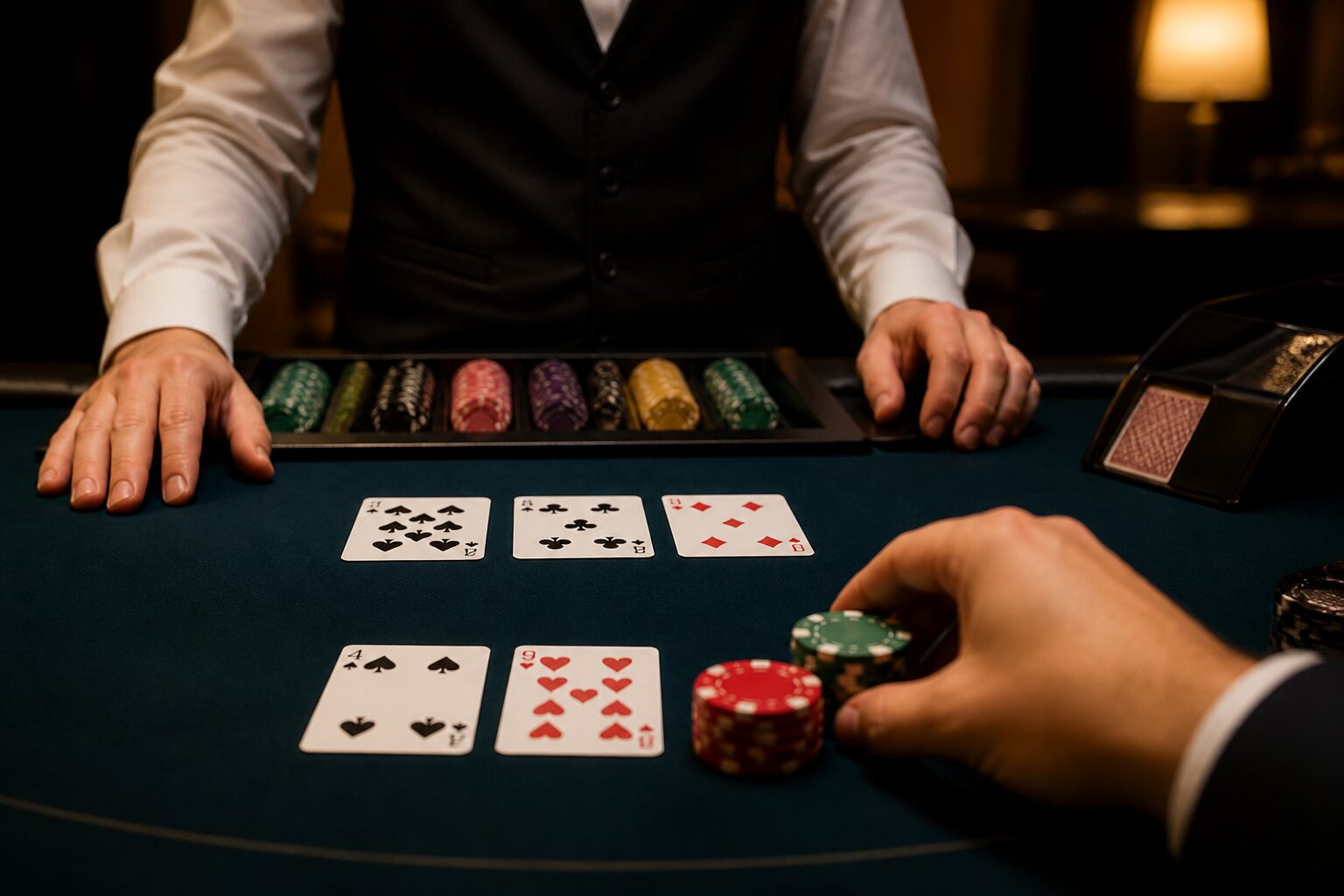
Blackjack already has plenty to keep a player engaged, but side bets add an extra layer of interest. The 21+3 side bet mixes poker-style combinations with your initial blackjack cards, creating the chance for larger, occasional payouts.
One of the most eye-catching outcomes on the 21+3 paytable is Suited Trips. It sounds striking, and in this article you’ll get a clear explanation of what it means, how it can occur in play, and what hands to watch for. Read on to see how this particular side bet fits alongside the main game and what to expect at the table.
What Is the 21+3 Side Bet in Blackjack?
The 21+3 side bet is an additional wager placed at the start of a blackjack round that ignores the later play of the hand and instead evaluates a three-card poker hand composed of your two initial cards and the dealer’s face-up card. It is separate from the main blackjack bet and does not change standard blackjack strategy; its outcome is determined immediately after the initial three cards are dealt.
This side bet uses familiar poker concepts—flush, straight, three of a kind—but applied to the specific three-card combination formed by those three cards. Casinos offer different paytables, but the rarest and highest-paying result is usually Suited Trips, followed by straight flush, three of a kind, straight and flush. Because the side bet pays independently of the main game, it can produce a payout even when your blackjack hand does not win. Understanding how the three-card combinations are formed and which ones pay most will help set expectations for frequency and reward. This background will make the next section, which defines Suited Trips in detail, easier to follow.
How Does a Suited Trips Hand Work?
Suited Trips is a three-card combination in the 21+3 side bet that requires all three cards to share the same rank and suit. Because most casinos use multiple decks in the dealing shoe, it becomes possible for two or more copies of the same card — for example, a Queen of Hearts from separate decks — to appear in a single hand. When your two cards and the dealer’s upcard are identical in both rank and suit (each drawn from different decks in the shoe), that qualifies as Suited Trips.
To illustrate in practice: if you are dealt Q♥ and Q♥ from two different decks and the dealer’s upcard is another Q♥ from a third deck, those three cards together form Suited Trips. This combination is rarer than a plain three of a kind because it demands matching suits as well as rank, and because it relies on the shoe containing multiple decks.
Suited Trips differs from other three-card outcomes such as:
- Three of a kind (also called Trips), where rank matches but suits can be different.
- Straight or flush, which require sequential ranks or matching suits respectively but not identical ranks.
Because Suited Trips is one of the least likely three-card hands in a multi-deck game, it usually carries the largest payout on the 21+3 paytable. The next section shows typical payout levels so you can compare how much each hand might return.
Payouts for Suited Trips and 21+3 Hands
Payouts for the 21+3 side bet are based on the poker-style hand formed by your two cards plus the dealer’s upcard. Suited Trips is typically the top-paying hand, with progressively smaller payouts for straight flush, three of a kind, straight and flush.
Typical payout rates (these can vary by casino and game version):
Hand — Typical Payout
Suited Trips — 100 to 1
Straight Flush — 40 to 1
Three of a Kind — 30 to 1
Straight — 10 to 1
Flush — 5 to 1
Because paytables differ between games, it’s sensible to check the specific table before playing to know the exact rewards and how they affect the effective odds. The following section gives concrete hand examples so you can recognise each paid combination when it appears.
Suited Trips Hand Examples
Below are clear examples of the three-card combinations that commonly appear on a 21+3 paytable. Remember these examples assume a multi-deck shoe, which is what makes Suited Trips possible. In a single-deck game you cannot get three identical cards of the same suit, so these outcomes rely on multiple decks being used.
Three Suited Cards
This is the Suited Trips outcome: three cards of the same rank and the same suit, each coming from different decks in the shoe. Because the rank and suit all match precisely, this is usually one of the highest-paying side-bet outcomes on a 21+3 paytable.
Examples:
7♥ 7♥ 7♥
Q♠ Q♠ Q♠
3♦ 3♦ 3♦
Each example shows the same rank and suit on all three cards; that precise match is what makes it Suited Trips. The chance of this occurring depends on the number of decks in the shoe and the specific paytable used by the casino.
Mixed Three-of-a-Kind
Here the rank is the same across all three cards but the suits differ. This pays as a plain Three of a Kind rather than Suited Trips. It still wins on many 21+3 paytables, but the payout is typically lower than for Suited Trips.
Examples:
K♣ K♦ K♥
8♠ 8♥ 8♦
10♥ 10♣ 10♠
The matching rank is the common element; varying suits mean this is not Suited Trips. Such hands are more common than Suited Trips because the suits are allowed to differ while the rank stays the same.
Straight Flush Combinations
A straight flush in 21+3 means three consecutive ranks all in the same suit. These are considerably rarer than a straight or a flush alone and usually pay more on the side bet. They can involve low, middle or high sequences, including ace-high sequences when the rules recognise ace as high.
Examples:
5♠ 6♠ 7♠
9♦ 10♦ J♦
Q♣ K♣ A♣
Recognising these patterns helps you understand how different payouts correspond to hand structure. The next section covers how to place the side bet at an online table and what to look for on the betting layout.
How to Place a 21+3 Side Bet?
Placing the 21+3 side bet online is straightforward: select your chip value and add a stake to the designated 21+3 area before the dealer begins dealing. The timing is important because the wager must be confirmed prior to any cards being dealt; once the initial three cards are on the table, they will be evaluated automatically against the game’s paytable.
On most online tables the interface highlights the separate betting zones clearly and displays the current paytable for 21+3 so you can check potential returns before committing. After the cards are dealt the system checks your two cards and the dealer’s upcard for qualifying combinations and pays out any side-bet wins immediately.
If you prefer to manage exposure, use the account tools provided by the platform to set deposit limits or session reminders; these features help keep play controlled and in line with a personal budget. With placement covered, the following section explains why players add the 21+3 wager to their play and how it fits into overall expectations.
Why Choose the 21+3 Side Bet?
Many players add the 21+3 side bet simply because it changes the rhythm of a hand and introduces a distinct winning line independent of the main game. It offers the possibility of large, sudden payouts from rare hands such as Suited Trips or straight flushes, creating a different kind of excitement than standard blackjack outcomes.
That said, the statistical reality is that the side bet carries a higher house edge than the main blackjack game. While attractive paytables can tempt players, those larger rewards arrive infrequently, so the side bet is best treated as an occasional enhancement rather than a core strategy. Players who value occasional big wins and a more varied table experience may enjoy it, provided they manage stakes sensibly and keep it as an add-on to regular play.
Understanding the comparative odds in the next section will make it easier to judge how often those bigger payoffs can be expected.
House Edge and Odds Explained
The house edge on the 21+3 side bet is generally higher than the house edge on standard blackjack. Typical figures vary by paytable and rules but commonly fall in a range from about 3.20% up to around 8.00%, depending on the version being played. In contrast, a main blackjack game played with basic strategy often yields a house edge between roughly 0.50% and 1.00%.
Comparison of typical house edges:
Bet Type — Typical House Edge
Main Blackjack — 0.50% – 1.00%
21+3 Side Bet — 3.20% – 8.00%
Because the side bet is less favourable statistically, it should be viewed as an entertainment feature that offers occasional large payouts rather than a steady source of positive expectation. Keeping stakes consistent with a pre-set budget helps preserve enjoyment and prevents overexposure to the wager’s higher variance. With a clear sense of odds and payouts, players can make an informed decision about whether and how often to include the 21+3 side bet in their play.
Play Online Casino Games at Money Reels
We’d love to welcome you to our site, where you can enjoy casino games in your own time and style. There’s no rush—just an inviting space where you can play when it suits you.
Getting started is straightforward: simply create an account, make a deposit, and you're all set to play. We look forward to having you with us at Money Reels.
**The information provided in this blog is intended for educational purposes and should not be construed as betting advice or a guarantee of success. Always gamble responsibly.