
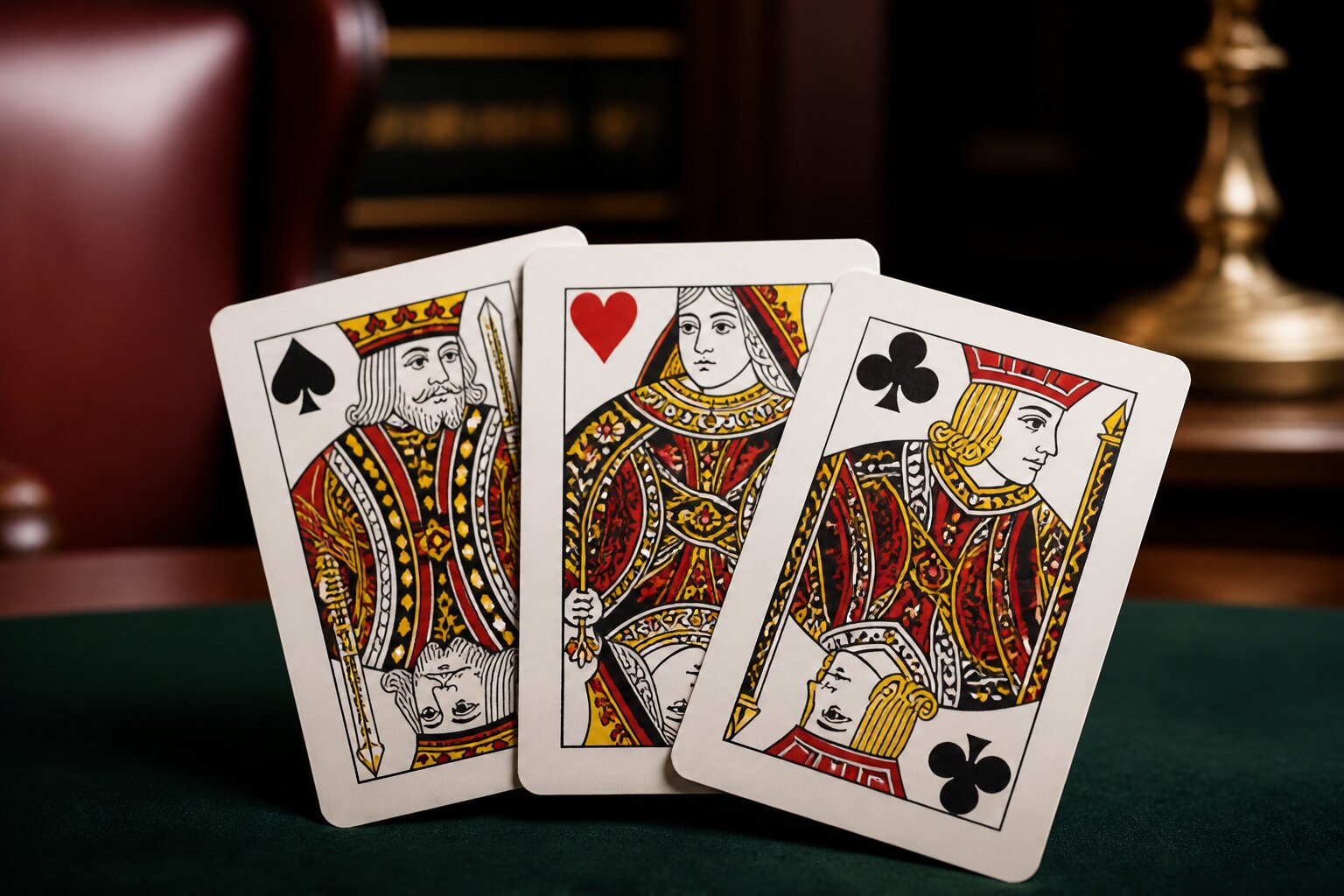
Ever wondered what makes some playing cards stand out from the rest? If you’ve played a game of cards, you’ve probably heard people talk about “face cards”—but what are they really?
Understanding face cards can sharpen your awareness at the table and reveal a little history behind the imagery on the deck. Whether you play often or are simply curious, this guide walks through what face cards are, how they function in games, and how designers keep them interesting.
Read on to start with the basics and then explore how these cards appear and behave in different games.
What Is a Face Card in a Deck of Playing Cards?
A face card is any card in a standard deck that shows a person’s face as part of its design. In the typical 52-card deck, each suit—hearts, diamonds, clubs and spades—contains three face cards: the Jack, Queen and King. These are recognisable by their illustrated royal figures, which cover the card’s upper area rather than showing only suit symbols.
Face cards are distinct from number cards, which display suit symbols and numerals. The Ace, while often high in value in many games, is not a face card because it lacks a human portrait. In total, a standard deck contains twelve face cards: four Jacks, four Queens and four Kings. The artwork is their defining feature; how they’re scored or used depends on the rules of each game.
Now that you know what a face card is, let’s look at how many appear in each suit.
How Many Face Cards Are There in Each Suit?
Each suit in a standard deck has exactly three face cards: one Jack, one Queen and one King. With four suits, that adds up to twelve face cards in total. This arrangement is consistent across ordinary 52-card decks regardless of visual theme or producer.
The fixed number and distribution make it straightforward to calculate frequencies and probabilities during play, and they also provide a stable structure for game rules and hand rankings. Because the face cards are evenly spread across suits, they often play a predictable role in the value of hands and in determining winners in many common card games.
With that clear layout in mind, the next question is why these cards are called “face cards” in the first place. Traditionally, they are referred to as face cards because they portray human faces on the card face, unlike number cards that display only pips. Over centuries the designs have evolved, but the portrait style has remained a defining feature that helps players recognise them at a glance.
Why Are They Called Face Cards?
The name comes directly from the design: these cards feature human faces. In early decks, the presence of a portrait made these cards easier to spot at a glance, which helped both players and dealers in fast play. The visible human figure became a convenient label, and “face card” has stuck ever since.
Historically, the characters depicted often reflected social ranks—servants, consorts and rulers—which helped players mentally order the cards. As printing and artistic styles changed across regions, the essential trait remained the same: a face was the defining visual marker. With that terminology established, it helps to examine the individual roles of the Jack, Queen and King.
The Different Face Cards: Jacks, Queens, and Kings
Face cards fall into three ranks: Jack, Queen and King. Each carries its own traditional imagery and cultural connotations, which designers and players have interpreted in various ways over centuries. Their consistent presence across different card decks has helped establish a shared visual language that players instinctively recognise.
The Jack: Origins and Symbolism
Originally called the “knave,” the Jack represented a servant, soldier or court attendant. Over time, the label shifted to “Jack” to reduce confusion with the King marker, and the card came to be more commonly associated with youth and vigour. The Jack usually occupies the lowest position among face cards and is associated with youth and action, which is why some games place it below the Queen and King in rank.
In many historic and modern designs the Jack is shown in motion or holding a weapon, hinting at his role as an active member of the court. That energetic quality affects how games treat the Jack, where it can sometimes be used for special functions or to represent a transitional value between numeric cards and higher face ranks.
The Queen: Representation and Importance
The Queen often appears as a dignified figure symbolising influence or counsel within the court. Her inclusion in decks reflects historical changes in portrayals of female authority in art and society, and different cultures have emphasised varied aspects of the Queen’s character. In many games the Queen ranks between the Jack and the King, providing a middle tier within the face card hierarchy.
Artists have alternated between depicting Queens as serene and stately or as more commanding and strategic, which influences how players interpret their role. The Queen’s position as an intermediary makes her a versatile card in play, sometimes functioning as a power card, sometimes as a stabiliser within a hand.
The King: Role and Meaning
The King stands as the highest face card and traditionally represents leadership and final authority within the suit. Over time, King imagery has been simplified or stylised but remains a marker of top rank among the three face cards, often making it strong in games that value high card ranks. The King’s iconography typically evokes sovereignty and control, reinforcing his status in the deck.
In practical terms, the King’s prominence has led designers to give it distinctive features so it is instantly recognisable during fast play. As a result, the King often plays a decisive role in hand comparisons and scoring, where its high position can determine outcomes in games that rank cards by face value.
These character differences inform how games value and use face cards. Next, we will cover how they function in common games and what that means for play.
What Do Face Cards Represent in Card Games?
Face cards can carry fixed numeric values, act as high-rank cards in hand hierarchies, or serve special functions defined by a game’s rules. The precise role varies from one game to another, and understanding those distinctions helps make sense of gameplay decisions.
In blackjack, for instance, Jacks, Queens and Kings all count as ten points, which simplifies scoring close to the target total of 21. In poker variants like Texas Hold’em, face cards are typically higher than most number cards and can combine into strong hands such as pairs or sequences. In baccarat, face cards count as zero when calculating hand totals, which alters the strategic value they hold compared with games like Blackjack.
Some games use face cards for particular actions—trumping, turning over bonus cards, or triggering side effects—so their importance can be tactical as well as numeric. With these differing functions in mind, the next section examines specific popular games to show these principles in action.
How Are Face Cards Used in Popular Games?
Across well-known card games, face cards take on roles tailored to each rule set. In Blackjack, their uniform value of ten means a single face card can form a strong base for a high-scoring hand. In Poker, a pair of Kings or Queens is often a substantial holding because of their rank and rarity. In Baccarat, the zero value for face cards changes how hand totals are calculated and can produce unexpectedly low totals where number cards might otherwise dominate.
Even within similar game families, small rule differences shift a face card’s impact. For example, in some rummy-style games face cards may be needed to complete melds, while in certain trick-taking games a King might outrank a Queen but still lose to a suitably designated trump card. Each game defines the strategic weight of face cards, and that variety is part of what keeps card games engaging.
To clarify how face cards compare with other types of cards, the next section lays out the key differences between face and number cards.
Face Cards vs Number Cards: Key Differences
The first obvious contrast is visual: face cards feature human portraits, whereas number cards show suit symbols and numerals. Functionally, face cards often have fixed or higher values in many games, while number cards usually correspond directly to their printed number. There are more number cards in a deck—thirty-six versus twelve face cards—so number cards typically appear more often during play.
These differences affect probability and strategy. A deck’s limited number of face cards makes them scarcer in any given deal, which contributes to their perceived value in games that reward high ranks or fixed-point values. Conversely, the abundance of number cards supports straightforward counting systems and combinations that rely on numeric runs or totals.
Understanding these contrasts helps when choosing strategies for particular games. That said, misconceptions about face cards still circulate; the next section clears up some of the common ones.
Misconceptions & Myths About Face Cards
Several persistent ideas about face cards are worth correcting. One is the belief that face cards appear less frequently in a properly shuffled deck; in truth, each card has the same probability of appearing, subject only to prior known distributions during play. Another is that particular face cards carry special powers or secret identities—while historical decks sometimes drew inspiration from real figures, modern decks do not assign official historical identities to Jacks, Queens or Kings.
It’s also important to avoid attributing outcomes to superstitions: card games rely on random dealing, not on inherent qualities tied to a card’s image. Focusing on rules, probability and sound play promotes better decisions at the table. Practising measured play and sticking to personal limits keeps games enjoyable and sustainable for more people.
As card design continues to change, face cards maintain their familiar roles while inviting new artistic interpretations—so next we turn to how modern designers approach these classic images.
Face Cards in Modern Card Design
Designers today balance tradition with contemporary taste when reworking face cards. While the rank and function of Jack, Queen and King remain stable, artists experiment with costume, posture, colour and composition to make decks that appeal to collectors and players alike. Some decks adopt minimal outlines and flat colour palettes; others embrace ornate, historically inspired detail or thematic motifs linked to film, literature or culture.
Limited-edition releases and artist collaborations have made face cards a canvas for creative expression. Digital printing and online marketplaces let small designers reach niche audiences, so variations that once were rare are now widely available. Even when radically restyled, a face card still needs to be legible at a glance and fit into the deck’s overall hierarchy, which constrains how far designers can stray from the essentials.
These evolving visuals keep face cards lively and relevant whether they’re used in serious play or collected for their artistry. Taken together, the shared history, clear function and ongoing design innovation explain why face cards remain such a central part of the deck.
To sum up, face cards are more than decorative flourishes: they have clearly defined roles, a stable place in deck structure, and a variety of uses across games. Their imagery links the practical side of play with centuries of design, keeping the deck both useful and interesting for players and collectors alike.
**The information provided in this blog is intended for educational purposes and should not be construed as betting advice or a guarantee of success. Always gamble responsibly.