
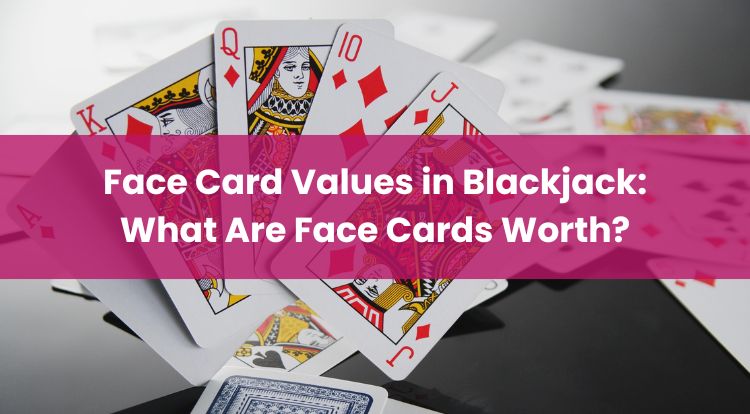
Blackjack is one of the most recognisable casino games, and understanding the role of face cards is a simple way to make sense of how hands are counted and compared.
Face cards shape totals, influence how the dealer plays, and can affect payouts. This guide explains which cards are classed as face cards, what they are worth, and how they fit into common blackjack situations, with clear examples along the way.
If you choose to play, set personal limits and only use money you can afford to lose. Support is available if you ever need it.
What Value Do Face Cards Have In Blackjack?
In blackjack, all face cards have the same value. The king, queen, and jack each count as 10 points.
This means that whether a player receives a king, a queen, or a jack, each one adds 10 to their hand total. The value does not change with suit or colour, and face cards have no extra powers beyond counting as 10.
Keeping this fixed value in mind makes it easier to read a hand at a glance and understand how close it is to 21. So, which specific cards count as face cards?
Which Cards Are Considered Face Cards?
In a standard deck of playing cards, face cards are the ones that feature an illustrated picture of a person.
The three types of face cards are the king, queen, and jack. Each suit in the deck (hearts, clubs, spades, and diamonds) contains these three face cards.
Face cards are different from number cards (2 through 10) and the ace, which plays a unique role in blackjack and is not considered a face card.
If a player is learning how card values work in blackjack, recognising which cards are face cards helps decision-making feel clearer from the outset.
How Many Face Cards Are There In A Deck?
A standard deck contains 52 cards in total, divided into four suits: hearts, clubs, spades, and diamonds.
Each suit has three face cards: the king, queen, and jack. That makes 12 face cards per deck.
There are four kings, four queens, and four jacks, with one of each in every suit. Knowing this spread helps when thinking about how often 10-value cards appear during play.
With the make-up of the deck in mind, the next question is how likely it is to draw one.
What Is The Probability Of Drawing A Face Card?
In a standard 52-card deck, there are 12 face cards.
To find the probability of drawing a face card on a single pick, divide 12 by 52. Simplified, that is 3 out of 13, or about 23%.
The chance changes after each card is dealt, especially when several rounds are played from the same deck or shoe, because the composition of the remaining cards is no longer the original 52.
Now that the numbers are clear, it helps to see how those 10-value cards shape the totals that matter most at the table.
How Do Face Cards Affect Your Hand Total?
In blackjack, each face card adds 10 points to a player’s hand total. This applies to kings, queens, and jacks.
Because of this fixed value, face cards quickly push a total upward. For example, a hand with a king and a 7 totals 17 points. A face card combined with a 10 makes 20, which is strong against many dealer outcomes, while pairing a face card with a low card may still leave room to improve.
Since the aim is to reach as close to 21 as possible without going over, the large share of 10-value cards in the deck affects how often totals like 17, 18, 19, or 20 appear. That is why players often pay close attention to whether the next card could be worth 10.
When an ace is involved, the same 10-value becomes even more significant.
How Do Face Cards Work With Aces For A Natural Blackjack?
In blackjack, a natural blackjack is achieved with the first two cards dealt: an ace and any card valued at 10. This includes all face cards.
An ace may count as either 1 or 11, depending on what benefits the hand. If a player receives an ace and a face card together, the ace counts as 11 and the face card as 10, making a total of 21. This two-card 21 is called a natural blackjack.
A natural blackjack usually pays more than a standard winning hand, though the exact payout depends on the table rules. If the dealer also has a natural, the round typically ends in a push where the stake is returned.
Those same 10-value cards also influence how the dealer’s hand develops.
How Do Face Cards Affect Dealer Play And Payouts?
Face cards can have a noticeable impact on how the dealer plays and how payouts are calculated in blackjack. As each face card counts as 10 points, they can move the dealer’s total to 17 or higher quite quickly.
Under common rules, the dealer must draw until reaching at least 17, then stand. If the dealer draws a face card while showing a 7, for example, that reaches 17 and the dealer stops. Some tables require the dealer to hit on a soft 17, which can change how often an extra card is taken, but the fixed 10-value of face cards remains a key driver of the final total.
Payouts are also linked to face cards through natural blackjacks. If a player’s first two cards are a face card and an ace, this may result in a natural that usually pays more than other winning hands. If the dealer also draws a natural, the round may end in a push.
Examples Of Hands With Face Cards
Having practical examples can make it clearer how face cards appear in blackjack hands.
Example 1:
A player receives a queen and an 8 for a total of 18. If the dealer shows a king and a 6 (making 16), the dealer must draw again to reach 17 or more, as required by typical house rules.
Example 2:
If a player’s cards are a jack and an ace, this hand totals 21 and may be considered a natural blackjack, potentially leading to a higher payout if the dealer does not also have a natural.
Example 3:
A dealer has a face card and a 7, totalling 17. Under most rules, the dealer must stand at 17, and no further cards are drawn.
Face cards frequently shape hand totals and the flow of play for both the player and the dealer.
If you choose to play blackjack, set sensible limits, use only money you can afford to lose, and take breaks to keep play in perspective. If gambling starts to affect your well-being or finances, seek support early.
Independent organisations such as GamCare and GambleAware offer free, confidential help for anyone who needs it.
**The information provided in this blog is intended for educational purposes and should not be construed as betting advice or a guarantee of success. Always gamble responsibly.