
Think you know the best and worst hands in blackjack? Myths about which hands will make or break your game are common—and not all of them hold up when you look at the facts. Whether you’re new to blackjack or play regularly, a clearer view of hand rankings helps you make better calls at the table.
This post separates the common myths from reality, explains which hands really matter, and offers practical context so your decisions rest on probabilities rather than hearsay. Ready to learn what actually makes a hand strong or weak? Let’s get started.
What Are the Best Hands in Blackjack?
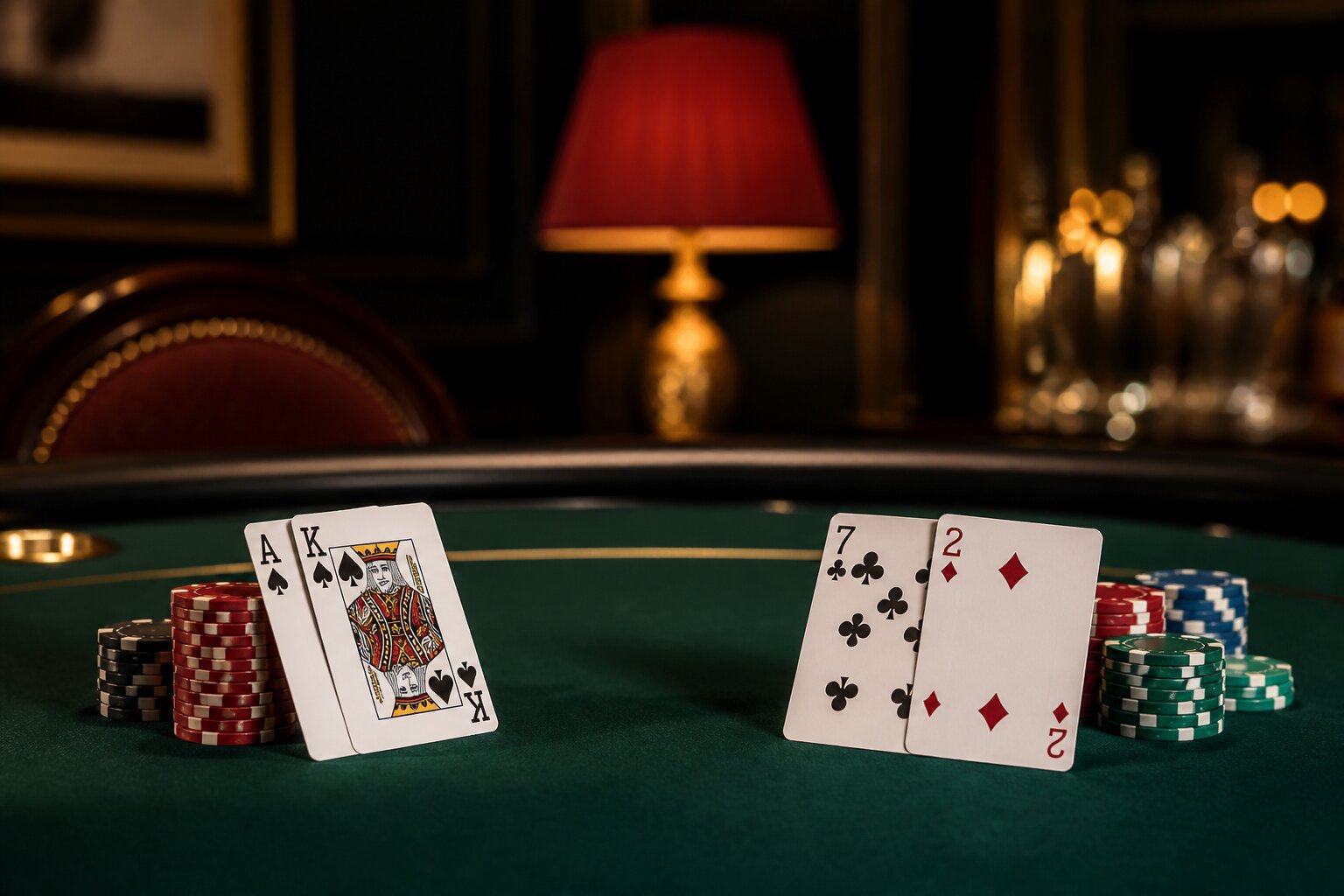
The top hand is the natural blackjack: an Ace plus any 10-value card (10, Jack, Queen or King). This two-card combination totals 21 and is paid differently from other 21s at many tables, so it is the most advantageous outcome on a given deal. The probability of being dealt a blackjack from a fresh deck is roughly 4.8%, so while it happens regularly over many hands, it is still relatively uncommon.
Other very strong hands include hard totals of 20 or 19, typically made from two 10-value cards or a 10 paired with a 9. These totals are difficult for the dealer to beat without making a 21, so they usually put a player in a firm position.
Two Aces as a starting hand are also valuable because they can be split into two separate hands. Splitting converts one awkward holding into two opportunities to reach high totals, and each resulting hand can pair with a 10-value card to form a strong total.
Knowing which hands are advantaged helps with subsequent choices at the table; next, we’ll look at the hands that commonly present the most trouble.
Understanding the Worst Blackjack Hands
Some totals place players in particularly awkward spots because hitting risks a bust while standing often leaves too little to beat the dealer. The most notorious example is 16, especially when the dealer shows a strong upcard. A 16 made from cards like 10 and 6 leaves few comfortable options: hitting may bust, standing frequently loses.
A total of 15 is similarly uncomfortable against dealer 10s or Aces, where neither hit nor stand offers a clear advantage. A total of 12 can be dangerous when the dealer shows a 2 or 3; hitting risks an immediate bust, while standing may surrender to a stronger dealer hand.
These hands are challenging because they sit in a narrow range where the probability of improving is balanced awkwardly against the probability of going over 21. Understanding that balance guides better decisions on whether to take another card or to allow the dealer to act.
Common Hand Ranking Myths Debunked
Misunderstandings about hand strength can steer players toward poor choices. Clearing up these myths gives a firmer basis for how to play different totals and when to change approach. Better comprehension of the rules and typical outcomes helps reduce costly errors and supports more consistent decision making.
Why 21 Is Not Always a Guaranteed Win
A total of 21 does not automatically win. If a player reaches 21 with three or more cards and the dealer has a natural blackjack, the dealer’s natural takes priority. When both dealer and player have 21 but not naturals, the result is usually a push.
Only a two-card natural blackjack has the special status that can beat other 21s outright. This distinction matters because players who assume any 21 will always beat a dealer’s hand can be surprised by payouts and outcomes. Knowing the specific rules about naturals helps set accurate expectations for the round.
Are All Low Hands Really Bad?
Low totals are not uniformly weak. A total such as 12 or 13 can be strong when the dealer’s upcard indicates a high risk of the dealer busting, commonly when the dealer shows 4, 5 or 6. In those situations, standing on a low total may be preferable because dealer rules force additional draws that increase their chance of exceeding 21.
Context is everything with low hands. Factors such as the number of decks, dealer draw rules and whether the game allows surrender can all affect the correct decision. Treating low totals as automatically bad can lead to unnecessary hits and larger losses over time.
Does Card Order Make a Difference?
Card sequence has no bearing on the mathematical value of a hand. An Ace followed by a 10 and a 10 followed by an Ace produce the same totals when they form a natural. What matters is the total and how Aces are valued as 1 or 11 within that total.
The only time order affects play is in procedural matters, such as when players are dealt before the dealer or when splitting and doubling rules reference the first two cards. For scoring and strength, however, the composition and value of the cards are what count, not the order in which they arrived.
These clarifications lead naturally into the mechanics of how hands are scored, which is essential to apply strategy correctly. Understanding these points can help players make more informed, rule-compliant choices at the table.
How Do Blackjack Hand Values Work?
Card values are straightforward: number cards count at face value; Jack, Queen and King each count as 10; the Ace is flexible, counting as 1 or 11 as suits the hand best without exceeding 21. That flexibility is the key feature that makes some hands strong or salvageable when extra cards are drawn.
For example, an Ace and a 9 count as 20 by treating the Ace as 11. If the same Ace appears with a 7 and an 8, the Ace must count as 1 to avoid busting, yielding a total of 16. Multiple Aces are handled by choosing values that keep the total under or equal to 21 where possible.
Tables and digital interfaces usually show totals automatically, but understanding how Aces adjust and why picture cards are all worth 10 helps interpret those displays and choose the best option for each situation. With that foundation, we can better evaluate claims that certain hands are unbeatable or hopeless.
Misconceptions About 'Unbeatable' and 'Unwinnable' Hands
No hand is categorically unbeatable or doomed. A hard 20 is strong but can be beaten by a dealer 21. Conversely, a player’s 16 may look bleak but can win if the dealer exceeds 21. Over many deals, what matters is how decisions interact with the dealer’s forced play and the statistical likelihood of different outcomes.
Some players assume a dealer showing a 10-value card is destined to win; in practice, the dealer still follows fixed drawing rules that can lead to busts. Strategy aims to improve expected returns by responding to the dealer’s visible card and the player’s own total, not to eliminate variability completely. Maintaining a measured approach and sticking to sound probability-based choices is what preserves long-term playability.
Next, we’ll examine how the dealer’s visible card directly changes the choices available to a player and why that insight is central to strategic thinking.
How Does the Dealer’s Hand Affect Yours?
The dealer’s upcard dictates much of the strategic landscape because the dealer must follow set rules—typically drawing to 16 and standing on 17 or higher. When the dealer shows a weak upcard, such as 4, 5 or 6, the risk that the dealer will bust on subsequent draws increases. In those cases, a player might prefer to stand on lower totals, shifting the statistical pressure back to the dealer.
When the dealer shows a high upcard, such as a 10 or an Ace, the probability they will achieve a strong final total rises. That typically forces players to adopt more aggressive options in pursuit of a higher total. Decisions respond to these probabilities rather than guarantees: a sensible play reduces expected losses or increases expected gains against the dealer’s visible position.
Understanding how the dealer’s forced play interacts with your totals gives the clearest route to better decisions. Take this into account, keep probability in mind, and you’ll approach each hand with realistic expectations and a steadier strategy that serves you across many rounds.
Play Casino Games Online at Money Reels
Why not become part of our friendly community of players here at Money Reels? We welcome everyone who enjoys the excitement of casino games in a relaxed, enjoyable environment.
**The information provided in this blog is intended for educational purposes and should not be construed as betting advice or a guarantee of success. Always gamble responsibly.