
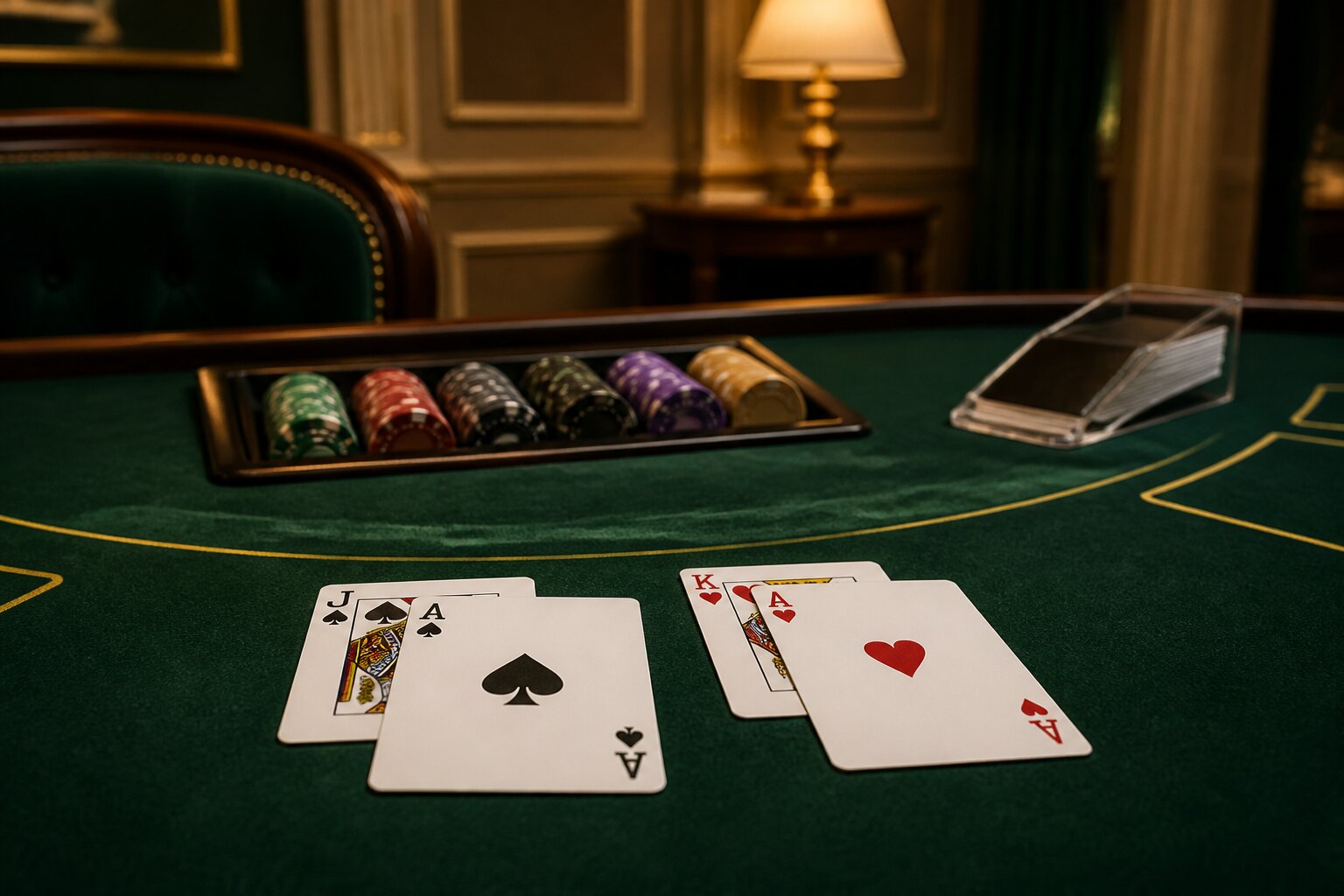
Picture yourself at a casino table, chips in hand, glancing between the dealer’s cards and your own – ready to make your move. You spot a game labelled “Blackjack” at one end, and another called “Pontoon” nearby. Both promise the tension of beating the dealer with a hand close to 21, but are they really the same game?
It’s a question that catches out even seasoned players. Maybe you learnt Pontoon as a family favourite, or you’re used to the brisk pace of Blackjack at a casino. It’s easy to assume they’re just two names for the same thing when the objective—reach 21 without going bust—sounds identical.
Dig a little deeper and the differences in rules, terms and strategy become clear. Understanding those differences helps whether you’re playing socially at home or trying a table for the first time in a venue. Next, we’ll outline the basic distinctions you’ll want to spot when choosing which table to play.
Blackjack vs Pontoon: What Are the Basic Differences?
At first glance both games aim for 21, but the table experience and mechanics set them apart. One practical difference is deck count: many Blackjack variants use multiple decks, which smooths out short-term swings, while Pontoon—especially the traditional British style—often uses fewer decks, which can make outcomes feel more variable.
Terminology is different enough to matter. Blackjack uses terms such as hit, stand, double down and split; Pontoon uses twist, stick, buy and split. Those words map to similar actions but the conditions and timing attached to them can vary quite a bit between games.
Payouts and hand priorities diverge too. Blackjack usually pays 3:2 for a natural 21 (an ace plus a ten-value card). Pontoon’s top hand, called a Pontoon, typically pays differently and always outranks the five card trick—a special hand in Pontoon made of five cards totalling 21 or under. In Blackjack there’s no separate five card rule; the best score simply wins.
The dealer’s card visibility changes strategy. In Blackjack the dealer usually shows one card face up, offering a clue for player decisions. In Pontoon both dealer cards are kept face-down until players finish, so choices rely primarily on the player’s own hand rather than intelligence about the dealer’s position.
These contrasts affect tactics, so it helps to know the rules at the table you join. I’ll now walk through those rule differences in more detail so you can see how they change play.
How Are the Rules of Blackjack and Pontoon Different?
The sequence of play and when certain options are available are where the rule differences become most apparent.
Dealing and visibility: Blackjack typically reveals one dealer card, which informs player choices. Pontoon keeps both dealer cards face-down, so decisions rest on the player’s visible cards and the statistical chance of improving them.
Drawing requirements and options: Blackjack allows players to stand on any total. Pontoon usually requires players to twist until they reach at least 15, at which point they may stick. This mandatory twisting lowers the player’s control over very low totals and changes the expected path of a hand.
Doubling (buying): In Blackjack, doubling down is usually limited to the first two cards; players double, take one additional card, then stand. Pontoon’s buy option can be used on two, three or four cards—so long as the player has not yet stuck—offering more opportunities to increase a stake mid-hand.
Splitting: Both games allow splitting pairs, but Pontoon often applies tighter restrictions on when and how splits can be played. The result is that split strategy in Pontoon can be more constrained than in many Blackjack variants.
Hand rankings: A natural twenty-one (ace plus ten-value) is the top Blackjack hand. Pontoon’s Pontoon is the equivalent top hand but sits above the five card trick, which beats other hands of lesser rank. In Blackjack there’s no five card priority, so similar totals are resolved simply by whose score is closer to 21 without busting.
Dealer play: Blackjack dealers commonly stand on 17 or higher and draw to 16 or lower. Pontoon dealers normally complete their hands after all players and local rules determine their exact drawing requirements. One rule that often surprises players is that in some Pontoon versions a tie goes to the dealer.
With those rule contrasts in mind, next we’ll highlight how the two games share core elements despite these differences.
Similarities Between Blackjack and Pontoon
Underneath the different names and practices, the games share a clear foundation.
Both centre on achieving a hand value as near to 21 as possible without exceeding it. Card values are treated the same way: number cards count at face value, picture cards count as 10, and aces can be 1 or 11 depending on what best serves the hand. That consistent valuing keeps the arithmetic familiar across both tables.
Player choices are conceptually similar. Whether a player chooses to take another card or to stand with their current total, the decision balances the prospect of improving the hand against the risk of going over 21. Splitting pairs and increasing a wager after the deal are tactics present in both games, even if the timing and limits differ.
Both games pit individual players against a dealer who acts after the players, preserving the same basic conflict: beat the dealer’s hand without busting. The formats can be social and competitive in a similar way, whether at a live table or online.
These shared elements make it relatively easy for players familiar with one game to pick up the other, once they adjust to the specific rules. To understand how often each game turns up in the UK and where you’re likely to find them, read on.
Which Game Is More Popular in the UK?
Blackjack enjoys wider availability across UK venues and online platforms, appearing in numerous variants such as classic, European and live dealer formats. Pontoon exists and is enjoyed, particularly in informal, home-style play, but it appears less frequently on commercial casino floors.
Industry data and venue offerings consistently place Blackjack among the most played table games. Pontoon tends to turn up more rarely in commercial settings and is often encountered in social play or on specialist online tables rather than as a staple of every casino.
If you’re seeking the broadest choice of tables, Blackjack will usually be easier to find. The next section looks at where these games came from and how their rules developed into the forms players know today.
Origins and Evolution of Blackjack and Pontoon
Both games trace their ancestry to the European twenty-one family but followed different paths as they spread and adapted.
Blackjack evolved from French games such as Vingt-et-Un. As it moved through Europe and to English-speaking countries, rule changes were introduced to improve pace and spectator appeal. Elements like dealer standing on certain totals, standardised payouts for natural twenty-one, and the acceptance of multiple decks are all part of Blackjack’s commercial evolution.
Pontoon likely developed from the British version of vingt-et-un and retained a strong informal, household tradition. Its distinguishing features—the use of terms such as twist and stick, the five card trick, and the buy option at later points in a hand—reflect a game shaped by different social settings and preferences. Casino variants of Pontoon have altered some home rules to suit commercial play while preserving the core character of the game.
Over time, both games accumulated variants that reflect player preferences: some favour faster rounds, others introduce rule tweaks to balance player options against house advantage. With that history in mind, the final section compares how those rules and traditions translate into the experience at the table.
Gameplay Experience: What to Expect from Each Game
Playing Blackjack often feels measured and strategic. The visible dealer card gives players a signalling point for decisions, and the pace at live tables allows time to weigh options like splitting or doubling. Social interaction can be part of the appeal as several players compete against the dealer simultaneously, each making independent choices.
Pontoon tends to deliver a greater sense of suspense. With both dealer cards hidden, every decision is made with less visible information, and the requirement to twist until at least 15 changes how hands develop. The ability to buy on more than two cards creates moments where a player might increase their stake later in a hand, which can heighten drama.
Both games reward an understanding of their specific rules. Familiarity with when doubling is permitted, how splits are handled, and how dealer ties are resolved will shape sensible choices and expectations. Players should treat these games as entertainment and manage their play accordingly by setting limits and staying within them.
Whichever table you choose, knowing the rules you’re about to meet makes the experience more enjoyable and less surprising. If you’re trying a new table, take a moment to check the house rules before you play so the actions available to you are clear.
Play Casino Games Online at Money Reels
Fancy exploring something a bit different for your next bit of entertainment? We invite you to discover the fun of playing casino games with us at Money Reels.
Getting going is straightforward: just create your account, make a deposit and you are all set to play. We look forward to welcoming you and hope you have an enjoyable time on our site.
**The information provided in this blog is intended for educational purposes and should not be construed as betting advice or a guarantee of success. Always gamble responsibly.